Get Full Government Meeting Transcripts, Videos, & Alerts Forever!
Get email alerts on the Transportation Infrastructure topic
No spam. Unsubscribe anytime.
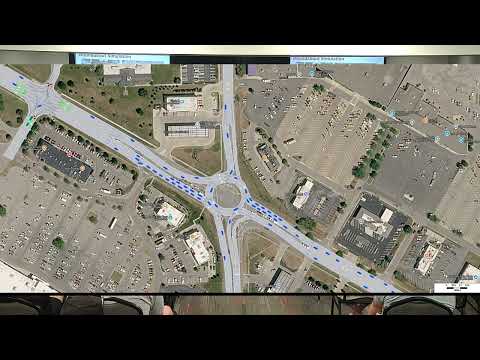
Consultants recommend roundabout at busy Troy intersection; council and residents press for truck, pedestrian and funding details
Summary
Consultants told Troy council a two‑lane roundabout at West Main (41)/South Stanfield/Experiment Farm would reduce severe crashes and balance delays. ODOT would fund ~$2.57M; remaining costs would come from local TIF funds. Council and residents pressed on truck access, pedestrian crossings and construction staging.
Tony Lenhard, roadway project manager with American StructurePoint, and traffic engineer Garav Cash presented the study and recommended a two‑lane traditional roundabout for the intersection of West Main (41), South Stanfield and Experiment Farm.
Garav Cash summarized the safety case: “injury crashes are occurring every year…there is a safety problem at this intersection and that is exactly what this project is designed to fix.” He and Lenhard said the roundabout removes crossing movements that cause angle crashes and reduces rear‑end crashes connected with signal stops.
The consultants presented three scenarios: keep the existing signal (no‑build), an improved signal with additional turn lanes and optimized timing, and a roundabout. They showed modeled travel‑time and delay results they said favor the roundabout for balancing delay among approaches and reducing severe crashes. Preliminary construction estimates presented were about $4.27 million for the signal option and about $4.29 million for the roundabout; consultants said annual maintenance costs would likely be higher for a signal (~$10,000/year) than for a roundabout (~$1,500/year), producing long‑term lifecycle savings.
City staff and the consultants outlined funding: ODOT is expected to contribute roughly $2.57 million, the city has already secured about $700,000 for design, and the remaining local share would come from a tax‑increment financing (TIF) dedicated fund rather than the general fund. “ODOT contributing $2.57 million,” staff said when asked how the project would be paid for.
Council members pressed the consultants on several points. Councilmember Siver said the city’s earlier capacity analysis suggested work might not be required until 2047; consultants clarified that 2047 was the design year (a 20‑year planning horizon) used to size improvements. Councilmembers raised site‑specific concerns including sun glare at certain approach angles, existing approach speeds of 40–50 mph, whether a roundabout would improve pedestrian safety in practice, and whether the roundabout would produce more low‑speed fender‑benders while reducing injury crashes.
Residents and business representatives spoke during the public comment period. Several local business employees and truck drivers said the corridor carries heavy semi‑truck traffic to area manufacturers and distributors; Joyce Copic, who works on Experimental Farm Road, told council that “the truckers do not want to see a roundabout there.” Other public commenters backed the roundabout for reducing severe crashes and improving pedestrian refuge distances.
Consultants said the design accounts for commercial vehicles with truck aprons and swept‑path (AutoTURN) analyses. They said the proposed outside‑to‑outside roundabout diameter is about 150–160 feet with two through lanes on most approaches, and that detailed design would include signage, pavement markings and possible rapid‑flashing beacons or raised crossings to aid pedestrians.
Staff told council the feasibility study will be reviewed by ODOT and that the project is targeted for construction in state fiscal year 2029; if council declines to proceed the city would forfeit the $2.57 million ODOT contribution and could lose competitive points on future grant rounds. No formal decision or vote occurred at the meeting; staff said council would consider options and next steps at upcoming meetings, with a council meeting scheduled July 6.
What’s next: city staff will complete feasibility inputs for ODOT review, the council will weigh the two alternatives and funding obligations, and detailed design (including a traffic management plan for construction) would follow any decision to proceed.