Get Full Government Meeting Transcripts, Videos, & Alerts Forever!
Get email alerts on the Rural Housing topic
No spam. Unsubscribe anytime.
University Extension expert urges towns to treat homes as community assets to free workforce housing
Summary
Ben Winchester (University Extension) told Olivia’s housing committee that population loss masks a stable housing stock and urged policies (land trusts, pre-sale inspections, patio-home options) to encourage housing succession so younger workers can move in.
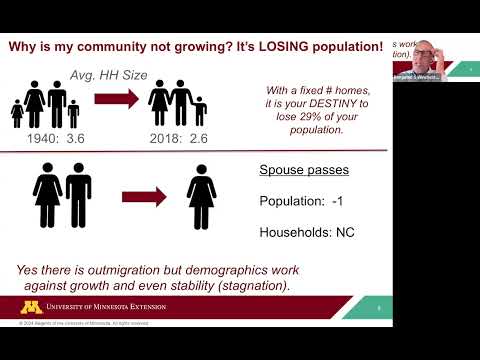
Ben Winchester, a community-development educator with University Extension, told Olivia’s housing committee that declines in total population do not always mean housing supply is empty and that older homeowners staying put are a major constraint on available workforce housing. "Our homes are still full," Winchester said, arguing the average household size has fallen and that many homes remain occupied even as population counts fall.
Winchester presented data from regional studies showing households have remained steady or increased in some rural areas even as total population fell, and he said newcomers often move for lifestyle reasons — a simpler pace of life, safety and lower housing costs — rather than local jobs. "You don't have a labor shortage; you have a housing shortage," he said, pointing to commuting patterns that decouple where people live from where they work.
He described a pattern he called the "policy of best intentions," in which communities invest in home modifications (ramps, bathroom updates) that help seniors age in place but reduce housing turnover. "These are the types of decisions that get made in a policy of best intentions," Winchester said, noting some households spend thousands on livability improvements that do not make the home attractive to new buyers.
Winchester recommended several community tools: interviewing older residents about their willingness to move, conducting pre-sale inspections for homeowners over 55 to assess likely rehabs, pursuing land trusts to control land costs and building a local "home rehab" toolbox or Habitat-style rehab program. He also highlighted the economic ripple effects of household spending and said transfer receipts (Social Security, Medicare) are an increasing share of county income, which strengthens the economic case for keeping housing occupied and maintained.
During questions, committee member Jen asked whether housing and redevelopment authorities (HRAs) have programs that support alternative housing types and public incentives. Winchester said he has been working with regional development commissions on case studies and suggested tax credits, infrastructure assistance and land-trust models as options. Developer Steve asked how to quantify public contributions to private projects and whether community incentives could be structured to avoid perceived preferential treatment; Winchester said case studies and focused interviews aim to identify workable models.
The committee did not take formal action on Winchester’s recommendations during the meeting; Winchester offered to share his PowerPoint and follow up on case studies and data links.