Get Full Government Meeting Transcripts, Videos, & Alerts Forever!
Get email alerts on the Municipal Finance Fees topic
No spam. Unsubscribe anytime.
Olivia council debates 2025 fee overhaul; directs staff to revert subdivision fees and add 10% inflation adjustment
Summary
City council held a detailed first-reading discussion of Ordinance 20241 (2025 fine-and-fee schedule), questioned new charges for unconnected properties and appeals, and directed staff to revert to the 2024 subdivision fee breakdown, change the recorder fee to actual cost, and add a 10% inflation increase to application fees.
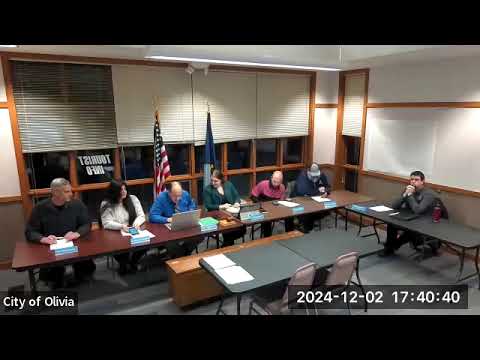
Olivia City Council spent the bulk of its meeting discussing the first reading of Ordinance 20241, the proposed 2025 fine-and-fee schedule, and directed staff to return with amendments that would restore the 2024 subdivision fee breakdown while applying a 10% inflation adjustment to application fees.
Staff presenting the ordinance said utility rate changes would include stormwater up 1%, sewer up 5%, water up 6% (noting the Highway 212 water-main project) and electric up 5%. The presentation also proposed a $10-per-month rural access charge affecting about 10 accounts outside the municipal limits, removal of a church demand per-kilowatt charge (placing churches under the commercial monthly base rate), and a new $8 public infrastructure support fee with $4 already directed into a reserve account. "There are about 10 accounts who are outside of the municipal limits who receive water service from the city," staff said, explaining the rationale for a rural access charge.
Councilors questioned whether charging property owners whose land is merely adjacent to infrastructure — or lots that are not buildable — is fair. One councilor argued that residents who already pay city taxes should not be assessed extra fees for infrastructure that passes their property; another countered that putting "some skin in the game" helps fund necessary system improvements when a parcel could hook to service in the future.
Councilors also debated changes to right-of-way permit fees and enforcement. Staff proposed raising in-boulevard ROW fees (to $100 from $75) and in-street first-block fees to $200 (from $150) with $100 for each additional block, and adding a refundable deposit for multi-block projects so the city can ensure contractors restore pavements to city standards.
A lengthy exchange focused on land-use and appeals fees. Under the proposed schedule, some appeal and amendment fees were higher than the 2024 amounts (examples discussed included raising a previous $125 fee to $200–$300). Concerns included the potential effect on low-income residents who may have legitimate appeals and the difficulty of setting a single flat fee for cases that vary greatly in staff time and outside expenses. Legal/consultant input noted that some cities charge unsuccessful appellants the city's incurred costs; councilors discussed making fees payable only if an appeal is unsuccessful. "If the appeal is successful, the city incurs those costs and if this appeal is not successful then you can put the costs on them," an advisor said during the discussion.
Council direction: members agreed to revert the subdivision and application fees to the 2024, more granular format rather than a bundled flat fee, change the recorder/recording fee to actual cost (the staff will provide the current county recording cost), and add a 10% inflation increase to application fees. Council also instructed staff to draft language that would make unsuccessful zoning appeals responsible for costs while waiving certain fees when the city initiates an ordinance update.
Staff said they would return with a clean ordinance for a formal first reading incorporating the council’s amendments, updated wording on recorder costs, and an estimate of staff hourly rates to inform research-fee language. The council did not vote on the ordinance at this meeting; the discussion concluded with an agreement to bring back an amended ordinance for formal consideration.
The council also approved other minor edits in the fee schedule (for example, simplifying a metal-detector security-deposit line to a single $20 charge) and retained the consent items approved earlier in the meeting.
The council’s next procedural steps are to receive the revised ordinance and supporting cost estimates from staff and schedule the formal first reading and subsequent action at a later meeting.