Get Full Government Meeting Transcripts, Videos, & Alerts Forever!
Get email alerts on the Home Energy Score topic
No spam. Unsubscribe anytime.
Eugene council directs city manager to schedule public hearing on home energy score disclosure ordinance
Summary
City staff presented a draft ordinance requiring sellers to disclose a home energy score in listings; councilors raised questions about cost, duplication with new federal appraisal requirements, exemptions and renter impacts before directing staff to schedule a public hearing. The motion to set a public hearing passed 8-0.
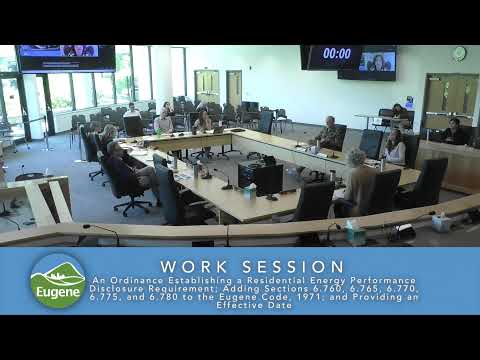
EUGENE — The Eugene City Council on June 24 directed the city manager to schedule a public hearing and set a date for deliberation on a draft ordinance that would require sellers to obtain and disclose a home energy score when listing a residence for sale.
City sustainability staff described the proposed Residential Energy Performance Disclosure Requirement as a policy to increase transparency about home energy use and to connect owners and buyers with recommended improvements and incentive programs. "It's to evaluate a variety of physical and mechanical features throughout a home…kind of like a miles per gallon rating for a car," a climate policy analyst said, describing the score and the accompanying report.
Staff said the proposed code would authorize the city manager to adopt administrative rules, provide exemptions for distressed or involuntary sales and housing types that cannot be scored, and require the score and report to expire after eight years or when an alteration changes a home's energy use. Staff estimated the requirement would take about half an FTE to manage and ongoing costs of roughly $100,000 per year; they recommended outreach, assessor training and a phased rollout.
Councilors raised several practical concerns. Councilor Clark asked whether the proposal would duplicate changes to federal appraisal forms (the UAD) that include energy-efficiency fields starting Nov. 2; staff said they would research the overlap and follow up. Councilor Kashinsky and others asked how to avoid penalizing sellers who make improvements between a score and a later listing; staff said the draft code treats alterations that change energy usage as invalidating a prior score and would require a new score.
Equity and renter impacts were discussed: staff cited research compiled by Earth Advantage indicating no statistically significant differences in scores by income tracts, and they noted renters and occupants may obtain voluntary scores but that specific incentives for renters would be a potential second phase of work.
Councilor Leech moved to direct the city manager to schedule a public hearing on the ordinance and set a date for council deliberations and possible action; Councilor Kashinsky seconded. The motion passed unanimously, 8-0.
Next steps: staff will schedule the public hearing, develop outreach and training materials for assessors and real estate professionals, and return to council for public testimony and deliberation.