Get Full Government Meeting Transcripts, Videos, & Alerts Forever!
Get email alerts on the Planning Permits topic
No spam. Unsubscribe anytime.
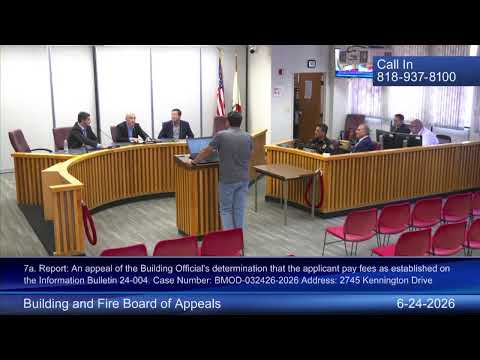
Glendale appeals board upholds fee requirement for Kennington Drive project; staff offers expedited recheck
Summary
The Glendale Building and Fire Board of Appeals upheld the building official's determination that the applicant for 2745 Kennington Drive must pay plan-check fees under information bulletin 24-004 and resubmit under the current (2026) code. Staff committed to an expedited in-house recheck if the applicant's design team re-engages and pays the required fee.
The Glendale Building and Fire Board of Appeals voted to uphold the building official's determination that the applicant for a new single-family home at 2745 Kennington Drive must pay applicable plan-check fees under information bulletin 24-004 and resubmit plans under the currently adopted 2026 Glendale Building and Safety Code.
At a hearing on the appeal (case BOD-32-426-2026), city staff outlined the project's review history: an original submission under the 2020 code, five rounds of plan-check review between November 2022 and September 2024, departmental approvals on Dec. 12, 2024, a restamp on Feb. 11, 2025, and permit-fee invoicing on April 24, 2025. Staff said the application became inactive after an extension expired on June 1, 2025, and cited Glendale Building and Safety Code sections 105.3.2 and 105.5 plus information bulletin 24-004 as the basis for requiring recheck under the current code.
Jacob Farock, who said he represents 101 Central Pacific Properties and identified himself as the appellant, told commissioners the project suffered prolonged review delays and that he had been unaware the RTI (ready-to-issue) status would expire. "We weren't aware that they were subject to expire after the permit was RTI," Farock said, describing funding timelines and a prospective buyer who was discouraged when told the plans had expired. He asked the board to consider relief from the extension fees or a short, goodwill extension so he could complete a sale or reengage his architect.
City staff acknowledged some inconsistent communications and said an information-bulletin email contained wording that caused confusion about whether a 50% fee or the full plan-check fee was required. The building official explained the city's intent: in-period extensions are generally processed for 50% of the plan-review fee, but once an application expires it must be brought into compliance with the current code and the city must collect fees needed to check for that compliance. The building official told the board that waiving the plan-check fee entirely would require city council action.
Staff described an additional step in the review chronology: after department approvals the plans went to a third-party plan-check consultant (JS Pacific) for the consultant's stamping and a final QA/QC step, which lengthened the timeline before the restamp in February 2025. Staff also said the city recently updated its contact-policy to encourage owners be listed on permit records so property owners receive expiration notices directly.
Commissioners pressed both sides on practical consequences. Several commissioners emphasized safety and the reason for applying current code cycles in high fire-severity hillside areas. One commissioner framed the choice as a balance between honoring prior approvals and ensuring homes meet updated life-safety, energy, and wildfire-related standards that can materially affect occupant safety. Staff noted that some technical code changes (for example, certain energy and mechanical provisions) may require only limited design work, while other items could be more significant depending on site-specific details.
To address the applicant's timing concerns, the building official committed to a streamlined, expedited in-house recheck if the applicant's design professional submits clear revision marks showing how plans would comply with the current code. Staff said that expedited recheck could reduce reliance on third-party review in this case, but that payment of the required plan-check fee would still be necessary unless council directed otherwise.
After deliberation the commission made a motion "supporting the building official's determination that the applicant pays fees as established on information bulletin 24-004," the motion was seconded and the commission voted to approve it. Commissioners recorded affirmative votes and the motion passed. The board did not grant a fee waiver; instead it confirmed the path staff described: the applicant may re-submit, pay the required fee (50% in-period guidance or the fee necessary for a current-code recheck as determined by staff), and pursue an expedited review if the design team cooperates.
The board closed the item and moved on to other business. The commission's action preserves the building official's interpretation of the code and bulletin while prompting staff to prioritize an expedited recheck if the applicant complies with staff's submission requirements and pays the applicable fees.