Get Full Government Meeting Transcripts, Videos, & Alerts Forever!
Get email alerts on the Public Safety Police Leadership topic
No spam. Unsubscribe anytime.
Reno’s new police chief emphasizes officer wellness, community policing and traffic safety
Summary
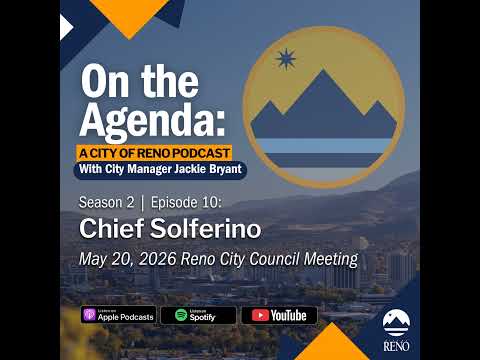
After the council ratified him, Chief Corey Solferino told a City of Reno podcast he will prioritize officer wellness programs, community policing to build trust, and attention to traffic crash investigations, while consulting other departments on effective, evidence-based approaches.
Reno’s newly sworn police chief, Corey Solferino, told the City of Reno’s On the Agenda podcast that his top priorities are officer wellness, community policing and reducing traffic-related harm.
Solferino, who was ratified by the Reno City Council before joining the podcast, said early-warning systems and wellness supports are essential for policing. "Our officers are an investment," he said. "If I'm a good sergeant, I'm going to go up and go talk to [an officer] and go, 'hey, what's going on, you know? Are you okay at home?'" He described his master's thesis on strain theory and maladaptive coping as central to shaping his approach.
The chief said Lieutenant Kelly Dunn is championing wellness work within the department and that he has consulted leaders in Louisville and Las Vegas Metro to identify the most effective, affordable priorities if funding is limited. Solferino said he will ask supervisors to watch for signs such as excessive use-of-force incidents, pursuits and citizen complaints as part of early detection.
On traffic enforcement and investigation, Solferino named vehicle-versus-pedestrian crashes and congestion as a priority. He highlighted the Major Accident Investigation Team (MAIT) and said traffic scenes can produce traumatic experiences for investigators that deserve attention and resources.
Solferino also emphasized community policing and approachability. "If we don't have that trust," he said, "then we're never going to understand what's happening in our communities." He said the department will pursue more forward-facing outreach and, in some cases, use less formal uniforming (polo and slacks rather than a full duty belt) for community events to reduce barriers to engagement.
On the podcast’s closing question about what he most wants residents to take away, Solferino said: "Trust. I've built a career and a legacy on trust ... I'm in the hallways. I'm in the community." He encouraged residents to raise concerns so the department can address them before they escalate.
Next steps: Solferino described program-level planning and outreach; he said funding details for wellness initiatives were still to be determined and that the department would prioritize evidence-based, cost-effective measures.
(Reporting based on the City of Reno "On the Agenda" podcast; exact appropriation amounts and timelines for the programs discussed were not specified.)