Get Full Government Meeting Transcripts, Videos, & Alerts Forever!
Get email alerts on the Budget Assessment topic
No spam. Unsubscribe anytime.
Petoskey Downtown board opens 2027 budget talks, weighs adding short-term rentals to assessment and restoring summer events
Summary
At an early review of the 2027 programs and services budget, the Downtown Management Board discussed whether short-term rentals should be treated as commercial property for the downtown assessment, and debated using assessment revenue or fund balance to restore the Sounds of Summer event to five weeks after sponsorship shortfalls.
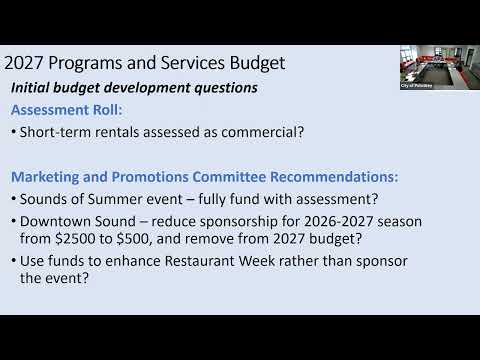
Downtown Director Amy Tweeton opened the board’s discussion of the proposed 2027 programs and services budget and asked for direction on two early questions: whether short-term rentals downtown could be treated as commercial property for assessment purposes, and whether limited use of the fund balance should be allowed to restore events that lost sponsorship revenue.
Tweeton told the board the city attorney is reviewing whether short-term rentals qualify as commercial uses and therefore could be added to the downtown assessment on a per-square-foot basis. She said the downtown currently has only “three or four” licensed short-term rental units, and that a legal determination is pending. The question for the board, she said, is whether those units—if classified as commercial—should be included on the assessment roll.
Why it matters: the programs and services budget for 2027 is relatively small and relies primarily on the special assessment and sponsorships. Staff reported the programs and services budget totals $214,720, with the annual special assessment projected to cover 58% of that amount, sponsorships budgeted at about 23%, proposed fund balance at 17%, and penalties/interest at 2%. If sponsorship revenue underperforms, staff warned the board will need to pull more from fund balance to cover program costs.
Board members generally described short-term rentals used less than 30 days as functionally similar to hotels for marketing and visitor purposes, while noting that long-term leased residential apartments are different. No formal decision was made; members asked staff to flag the legal opinion and return with any recommended policy language once the attorney’s determination is available.
Events and fund balance: the marketing and promotions committee recommended fully funding Sounds of Summer from assessment revenue after sponsorships fell short this year. Committee figures included roughly $9,500 in estimated production payments identified for the event with sponsorship revenues falling short of an amount the committee wanted to reach; staff and members discussed a $12,500–$13,000 budget target that would allow a fifth week of programming. Committee members proposed several options: (a) draw from fund balance for one year to keep the event at five weeks, (b) reallocate small sponsorships (for example a $500 chamber sponsorship for restaurant week) to enhance downtown-produced events, or (c) identify other line-item cuts.
Board members debated a fund-balance policy for programs and services. One framing under discussion was keeping one year’s worth of assessment revenue in reserve (staff cited roughly $125,000 as one-year assessment equivalency) while using the remainder to support events until sponsorship revenue recovers. Other members supported a smaller reserve (for example $100,000 or a six-month target) with limited use allowed for high-impact events. Several members stressed the need to present a clear rationale to City Council explaining when and why fund-balance draws would occur.
Operational context: board members noted a structural change since the parks/parking separation—parking revenue no longer automatically funds programs and services after offices split, leaving assessment and sponsorships as primary revenue sources for marketing. Staff also said much of event spend is advertising and talent/sound costs and that some events are largely fully sponsored and would remain so.
Next steps: staff will return with concrete budget figures in the coming months (projections should firm up by September–October) and with the attorney’s opinion on short-term rentals. The board signaled broad support for restoring Sounds of Summer to five weeks if staff can show how that will be funded without eroding an appropriate reserve level.
Ending: The board took no immediate votes on changes to the assessment or fund-balance policy; members asked for more detailed figures and legal guidance ahead of a future decision.