Get Full Government Meeting Transcripts, Videos, & Alerts Forever!
Get email alerts on the Ace Fund Budget topic
No spam. Unsubscribe anytime.
Children's Trust board uses $5.2M projection to hold child-care subsidy at 75%, fund ASD for six months and set 9% admin
Summary
The Anchorage Children's Trust board modeled a conservative $5.2 million ACE fund projection and populated member rankings that left the child-care worker subsidy at 75%, funded ASD for the July'December period at 100% (which commits future funding if repeated), set administration at 9%, and ranked operational grants above pilot/capital projects while planning advocacy to restore funds to the alcohol-tax source.
The Anchorage Children's Trust board on Friday used a conservative $5.2 million projection to shape its draft ACE (alcohol-tax) fund budget, keeping the child-care worker subsidy at 75%, approving funding for ASD for the July'December six-month period, and setting an administration cap at 9%.
"So just to remind folks the baseline facts is we're working off of $5.2 million," the board chair, Trevor, told members as he walked through projected deductions, rollover uncertainty and polling mechanics. Board members then completed an online ranking of how to allocate funds among child-care subsidies, operational grants, pilot/capital projects, ASD and Best Beginnings.
Why it matters: the board is operating without a guaranteed return of several programs to the alcohol-tax revenue stream that previously supported them. Several members said the current structure constrains what the $5.2 million can accomplish and urged a parallel advocacy strategy aimed at the mayor and assembly to restore or reassign funding sources.
Board actions and main outcomes
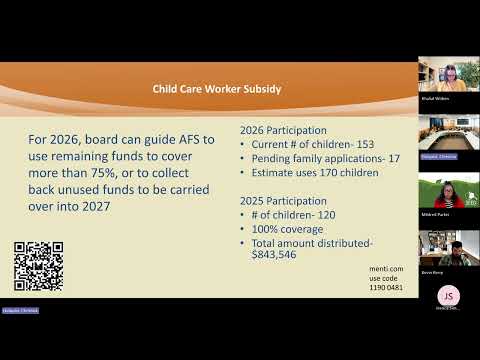
- Child-care worker subsidy: Members ranked and the board populated the budget using a 75% subsidy level (program covers 75% of eligible child-care costs; families cover the remaining 25%). Staff noted about 153 children are currently enrolled with 17 pending, for an estimated ~170 children if applications are completed. The board did not record a roll-call tally in the meeting transcript; the final populated figure used for planning was approximately $1.45'$1.5 million.
- ASD (ACE-funded preschool supports): After a conflict-of-interest disclosure that Jesse directly benefits from ASD funding (and would not vote on that item), Jesse described ACE-funded elements'classroom teachers and assistants for eight classrooms (about 142 children), mental-health consultants serving ~850 students/individuals, instructional coaching and curriculum supports. The board voted or ranked to fund ASD at 100% for the July'December six-month period (staff noted that committing to 100% for that six-month block implies an additional $1 million in the following half-year if repeated). The meeting record does not include individual vote tallies.
- Best Beginnings: Staff said $125,000 would buy and ship literacy books (~$37 per child per year), covering roughly 56% of that program's project for Anchorage recipients (they serve ~6,000 children). The board populated Best Beginnings funding at 50% (~$62,500) in the working model.
- Administration: The board populated an administrative percentage at 9% (about $468,000) based on a staff estimate of core costs around $370,000 and some margin for variability. Unused administrative funds roll into the general pot as rollover, staff said.
Debate and trade-offs
Members debated immediate service levels against preserving rollover funds for later months. Several board members warned that paying 100% of subsidies immediately could exhaust funds and force participation caps later in the year; others emphasized the stabilizing effect of operational grants for providers.
"This all sucks and it's a policy choice that the city's voters have made," Barry said, criticizing the broader tax choices that limit local revenue and urging systemic change while advocating for targeted priorities. Chuck and others pushed for prioritizing pilot and capital for long-term investments (building upgrades, playgrounds, training), while Georgina and other members argued operational grants and the subsidy stabilize providers and families in the short term.
Process notes and next steps
Board members used a ranking poll (Menti) to indicate preferences and then the chair populated the draft budget model. The model showed roughly $968,000 remaining before considering operational grants and pilot/capital allocations; staff cautioned that projected rollover is uncertain and estimated conservatively.
Trevor said the board will intensify advocacy with the mayor and assembly this summer to press for returning some programs to the alcohol-tax funding source and to present the board's rationale and data. Staff also noted an internal operations item: Carlos's ACE-funded position is structured in the Health Department and the team is working to transition that role under the current department for stable grants/contracts support.
The meeting closed with the board planning further modeling and outreach; the session adjourned at 10:31 a.m.