Get Full Government Meeting Transcripts, Videos, & Alerts Forever!
Get email alerts on the Entertainment District topic
No spam. Unsubscribe anytime.
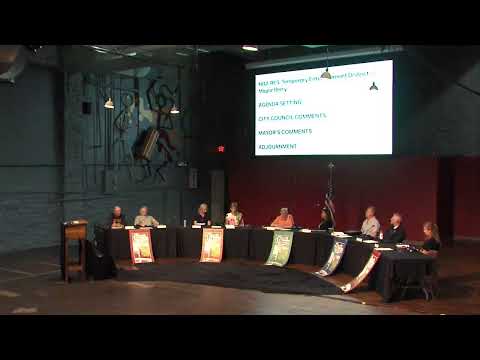
Eureka Springs Council approves 90-day downtown social-district trial after heated public debate
Summary
After hours of public testimony and ethics questions, Eureka Springs City Council voted to create a 90-day downtown social-district pilot with amended operational rules — 16-ounce approved cups, one open container per person, and required post-trial reporting — and directed city staff to monitor safety, sanitation and tax impacts.
Eureka Springs City Council voted on June 22 to approve a 90-day temporary downtown social district trial, a pilot program designed to let adults carry an approved beverage inside a designated area while the city evaluates public-safety, sanitation and economic impacts.
The resolution (No. 912) passed after extensive public comment from residents and business owners both opposing and supporting the proposal. Opponents repeatedly cited narrow, steep sidewalks, limited public restrooms and enforcement challenges; supporters — including downtown business owners and the Chamber’s tourism committee — said a short, revocable trial would provide practical data and help downtown businesses recover visitor spending.
Why it mattered: The vote came after repeated calls for clarity about conflicts of interest and whether council members with family ties to downtown businesses should participate. Linda McBride asked the city attorney to explain ethical rules and requested that Ward 1 Councilmember Michelle Moyer recuse herself because her spouse works for a downtown hotel. The city attorney advised the council there is no mechanism to force recusal and explained a recusal is required only where a direct pecuniary interest can be shown. Councilmember Moyer later said she would recuse herself from the vote; the council proceeded with discussion and amendments.
Operational changes adopted: Councilmembers amended the chamber’s application to tighten operations before approving the pilot. The key amendments adopted by motion were: a maximum cup size of 16 ounces (replacing the applicant’s 20-ounce proposal), a limit of one approved open container per person, and a requirement that the mayor (or mayoral designee) provide a public report to council within 30 days after the pilot ends summarizing specified metrics (law-enforcement incidents, alcohol-related violations, citywide sales-tax receipts and other KPIs).
City staff and law enforcement role: The police chief told the council he confronted a man with a bottle during a recent event and had the bottle discarded; he and other city staff said they would monitor incidents closely. Chamber representatives said the chamber would supply wristbands and cups to participating businesses and that business owners, not the city, would pay for wristbands and cups. The chamber said it plans to meet with police and city officials during the trial and could propose mapped expansions at 30-day intervals if data support enlargement.
What the council voted on: The final resolution created a bounded downtown “social district” trial, set hours and operational rules, and declared the program a revocable 90-day pilot. The language includes the amendments described above and assigns reporting responsibilities to the mayor’s office.
Next steps: The pilot will begin under the mapped boundaries approved by council. City staff and the police department will track incidents and enforcement data; the mayor’s office will present a report within 30 days of the trial’s conclusion to help the council decide whether to pursue a future ballot measure or other regulatory changes.
Voices from the meeting: "I stand in opposition to alcohol in the proposed social district," said Josie Yerby of 32 Vaughn Street during public comment. "Please let her. Love, connection, healing."
"If the police chief and council and the data that comes back suggests that we shouldn't do that, we of course would not push for that," said Colton Scriber, chair of the Chamber Tourism Committee, describing how the chamber would coordinate with city officials during the trial.
Mayor Robert Bush emphasized the pilot's reversibility and the council's ability to end the program quickly if data show negative impacts.
What was not decided: The council approved the trial authorization and operational conditions but did not adopt a permanent ordinance; any permanent change would require further action and — under the city’s current rules for ordinances — could be placed on a future ballot for voters.
Context and background: Eureka Springs has previously authorized temporary entertainment areas for single events. Opponents pointed to a city referendum that defeated a permanent entertainment district measure in 2020; supporters said local experience and comparable programs elsewhere now provide more practical evidence for a time-limited pilot. The council’s action implements a structured experiment intended to produce data on public-safety incidents, sanitation costs, and economic effects before any permanent change.