Get Full Government Meeting Transcripts, Videos, & Alerts Forever!
Get email alerts on the Cannabis Regulation topic
No spam. Unsubscribe anytime.
Bayport planners recommend conservative approach to hemp and cannabis zoning, urge mapping of buffer impacts
Summary
The Planning Commission reviewed a draft zoning amendment to regulate hemp and cannabis businesses, recommended a conservative initial cap on registrations and buffer distances from youth-oriented facilities, and forwarded the draft with Commission recommendations to City Council.
The Bayport Planning Commission recommended the City Council adopt zoning amendments to regulate hemp and cannabis businesses, advising a cautious start on the number and location of permitted operations and asking staff to map the practical effects of distance buffers on existing commercial parcels.
City attorney Christina Benson, who led the presentation, told the Commission that local control over cannabis is limited to "time, place and manner" zoning controls and summarized license categories the Office of Cannabis Management recognizes, including cannabis retailers, micro and meso businesses, cultivators, manufacturers and low-potency hemp retailers. She noted the statute requires that a jurisdiction permit at least one cannabis micro/meso/retailer per 12,500 residents, but that cities can limit the number of registrations on other policy bases.
Commissioners asked staff to propose conservative limits and to clarify definitions and performance standards. Several members favored starting with a small number of city registrations (many suggested one overall or "one of each" category), while reserving the right to expand if needed. Commissioners discussed buffer distances from schools, daycares, residential-treatment facilities and youth attractions; the discussion gravitated toward recommending a relatively conservative 500-foot buffer from schools for cannabis businesses and a smaller buffer for hemp-related, low-potency retail, but commissioners asked staff to run parcel-by-parcel buffer maps before the council sets final distances.
On operations and performance standards, staff recommended indoor-only activity by default, odor-control and ventilation requirements consistent with state guidance, limits on signage and hours of operation tied to existing special-event rules, registration and annual compliance inspections, and nontransferable one-year registrations that the city would inspect and renew. The draft also provides a process for temporary cannabis-event permits with council approval; staff recommended indoor events only for Bayport at this stage.
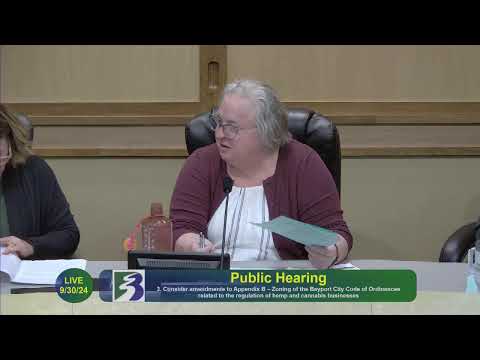
A public hearing on the draft ordinance drew no public speakers. After discussion, the Commission voted to forward the proposed Appendix B amendments to the City Council along with the Commission's recommendations (conservative registration counts, buffer preferences, indoor-event guidance and performance standards), and to ask the council to have staff prepare maps that show how buffer zones would affect existing commercial properties on Fifth Avenue and elsewhere in town.
City staff said the matter will return to Council with the Commission's recommendations and that registration-count decisions and specific buffer distances may be refined by council action after mapping and public comment.