Get Full Government Meeting Transcripts, Videos, & Alerts Forever!
Get email alerts on the Monitoring And Grants topic
No spam. Unsubscribe anytime.
Board plans to keep PurpleAir sensor network, accepts extra EPA 105 funds; ozone monitoring shows healthy readings
Summary
Staff told the board they will transition EPA‑loaned PurpleAir low‑cost sensors to local oversight and may apply for a loan or purchase sensors; the agency accepted around $90,000 in additional FY26 105 grant funds and reported strong monitoring completeness and ozone values well below critical thresholds.
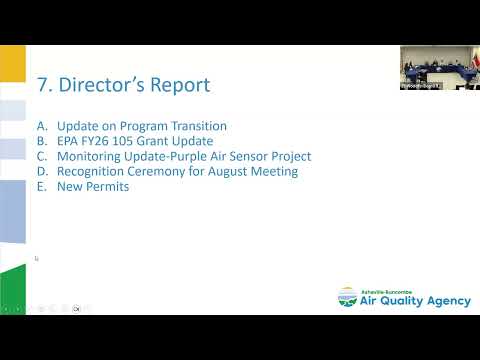
Agency staff described two linked monitoring and grant developments at the June 24 meeting: an offer from EPA to provide additional FY26 Section 105 funds and plans to assume stewardship of loaned PurpleAir low‑cost sensors used across the county.
Grant and budget details: Ashley said the FY26 Section 105 award was about $213,000 and that EPA offered an additional $90,000. She noted the program must meet maintenance‑of‑effort (MOE) obligations and that, because the program has six positions, accepting new funds requires careful budgeting. Staff said they plan to spend about $70,000 on a one‑time new ozone site and to use the remaining approximately $20,000 toward salaries and benefits; the one‑time ozone site cost can be treated as a budget amendment so it does not count toward ongoing MOE.
PurpleAir network and transition: Steve and James briefed the board on the PurpleAir loaner devices that EPA provided and the state and EPA’s role tracking serial numbers and quality assurance. Staff said the EPA/state loan term may be extendable for a year and that the agency intends either to continue the loan arrangement or apply for its own loan/purchase sensors to maintain the spatial network. Staff emphasized that PurpleAir sensors are not reference monitors but are useful for spatial coverage and wildfire‑smoke detection; they quoted typical unit costs in the "two to three hundred dollars" range and contrasted that with reference instruments that cost $20,000 or more.
Monitoring metrics: Steve reported monitoring completeness of 98.7% overall and 95.2% for PM2.5 so far this monitoring year, with no exceedances recorded in 2026. He said the fourth‑highest ozone value this year was 61 ppb (May 5), the highest was 65 ppb (April 3), and staff project a fourth‑highest design value near 59 ppb — well below a critical 96 ppb threshold for exceedance of the standard.
Implications: Staff recommended keeping a local PurpleAir presence for better spatial resolution, pursuing loan or purchase options, and maintaining a quality assurance plan if continuing with EPA loaners. They also noted increased federal scrutiny of grants and the potential for changing grant guidance from the Office of Management and Budget.
Next steps: Staff will coordinate with EPA/state for the sensor transition, pursue a loan or purchase application if necessary, and manage the FY26 budget amendment to cover the ozone site; these items will be part of the program transition to Buncombe County.