Get Full Government Meeting Transcripts, Videos, & Alerts Forever!
Get email alerts on the Setback Variance topic
No spam. Unsubscribe anytime.
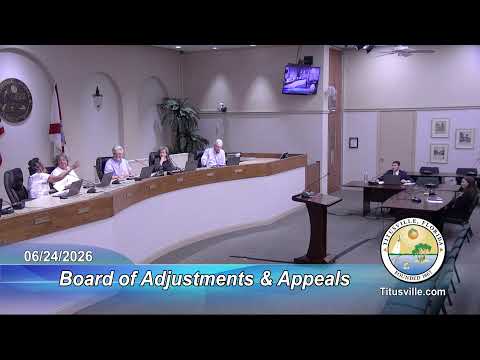
Titusville board denies zero‑foot setback for auto repair shop at 109 Fiser Avenue
Summary
The Board of Adjustment and Appeals voted to deny a request to allow a zero‑foot interior sideyard setback at 109 Fiser Avenue, citing a likely self‑created hardship and outstanding building and fire‑safety issues. Applicant David Rupy said the temporary covered tire rack improves safety and asked for time to come into compliance.
The Titusville Board of Adjustment and Appeals on July 24 denied a variance request that would have allowed a zero‑foot interior sideyard setback for a primary structure at 109 Fiser Avenue, a property used by Dave’s Automobile.
Staff had recommended denial, telling the board the 350‑square‑foot addition was constructed after a 2023 lot split and after the applicant submitted a building permit; staff concluded the hardship appears to be self‑created and noted the addition does not meet the 10‑foot setback required by the land development regulations (LDR §28‑317C). Staff also flagged unresolved building‑permit and life‑safety issues, including a required fire‑resistance rating for an exterior wall treated as adjacent to another building and concerns about foundation inspections and roof overhang encroachment.
“The hardship appears to be self‑created,” staff told the board, and recommended denial so the applicant would return to the building department to resolve permit and construction issues.
Applicant David Rupy, who identified himself as the owner of Dave’s Automobile, told the board his shop has grown substantially since 2018 and that he installed a temporary covered tire rack to address safety and environmental concerns — mosquitoes, tire storage, waste oil containment and runoff — while he sought other properties to relocate. He said he has since engaged permit consultants, hired an engineer and submitted plans for a building permit.
“I built that rack to cover things up and be able to store some equipment and those tires undercover,” Rupy said, adding he is willing to modify the structure and work with staff toward full compliance.
Board members questioned whether a smaller setback (five feet) or rearranging storage at a leased annex would address the need, but Rupy said the leased space lacks room for the quantities and workflow he needs. Several neighbors submitted letters of support, and one board member noted that local support weighed in the applicant’s favor, while other members emphasized the limits of the board’s authority when the building department’s technical requirements remain unresolved.
A motion to approve the zero‑foot setback failed for lack of a second. A subsequent motion to deny the variance — on the grounds that the hardship was self‑imposed — was seconded and carried in the roll‑call vote (Vice Chairwoman Van Deven: yes; Member Beckles: yes; Member Green: no; Member Willis: yes; Chairman Taylor: yes). The board directed the applicant to work with the building department to resolve fire‑rating, overhang/runoff and inspection issues before any change in status.
Next steps: the applicant will pursue required corrections and building permits; the board’s action leaves the addition subject to review and possible enforcement until permits and inspections demonstrate code compliance.