Get Full Government Meeting Transcripts, Videos, & Alerts Forever!
Get email alerts on the Alpr Flock Contract topic
No spam. Unsubscribe anytime.
Renton residents press city to end Flock license-plate reader contract, demand public meeting
Summary
Multiple Renton residents urged the City Council to terminate the city’s contract with Flock (ALPR license-plate readers), citing security incidents, vendor terms that they say permit data reuse, and concerns about federal sharing and ICE access; speakers asked for a community meeting, audits and a public timeline rather than immediate reactivation.
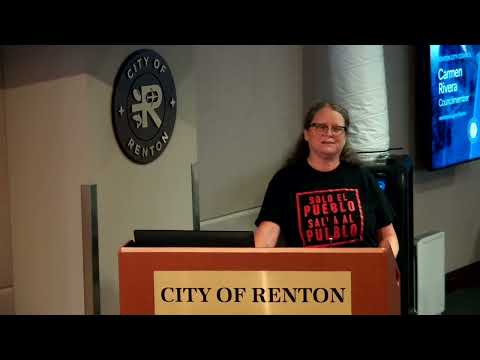
At the June 22 Renton City Council meeting, several residents called on the council to terminate the city’s contract with Flock, the vendor supplying automatic license-plate readers (ALPRs), and to hold a community meeting before any decision to reactivate the cameras.
“Flock does not keep data safe,” said Lesie Jensen, a Renton resident, citing an email from the chief of police that she read aloud and published concerns that cameras and vendor systems had experienced security incidents. Jensen said the police department’s email stated the department had “ceased any use” of ALPR systems and that those systems were “not currently capturing or storing any images,” but argued the response did not answer community-specific concerns she had submitted.
Adrien Higs, another Renton resident, urged the council to terminate the contract and to purge collected data. “This data will either be sold or leaked, guaranteed,” Higs said, describing how aggregated vehicle-location data could be used for corporate espionage, to reveal patrol patterns or to identify private addresses of officers.
Several other speakers echoed that call. Cheryl (participating remotely) asked that the city publish documents shared with the equity commission, demonstrate any practices that are more conservative than state law (SB 602), and schedule an expedited community meeting before any vote to reactivate cameras. Amy, another resident, specifically asked the council to give the 30 days’ notice required in the contract to terminate the Flock agreement.
Speakers also raised questions the transcript did not resolve: whether the city’s Flock privacy settings fully block federal or out‑of‑state sharing; whether retention rules and audit cadence are being observed in ways stricter than SB 602; and what technical controls exist to prevent off‑site access. Several named speakers pointed to vendor-term language that, they said, allows Flock to use derived data for AI training and to retain anonymized datasets.
Council members did not take formal action on the contract during the meeting. Mayor Arando Pavone acknowledged public concern and noted the council heard a large volume of public comment on the topic; the council then proceeded to routine consent and committee business. The meeting record shows multiple public requests for (1) a community meeting prior to any reactivation of ALPRs, (2) publication of audit and retention practices, and (3) consideration of terminating the Flock agreement and issuing any contractual notice required by the vendor agreement.
What happens next: The council did not vote on the Flock contract during this meeting. Residents asked the city administration for a public timeline and for transparency about privacy settings, audits, and any sharing with federal agencies; the transcript contains multiple requests that those items be supplied to the public before council is asked to vote.