Get Full Government Meeting Transcripts, Videos, & Alerts Forever!
Get email alerts on the City Budget topic
No spam. Unsubscribe anytime.
High Point council adopts updated budget and directs staff to include firefighters' separation allowance
Summary
After hours of debate over state tax moratorium impacts and the cost of a proposed Special Separation Allowance (SSA) for firefighters, the High Point City Council approved a revised budget with an 8.74-cent increase and asked staff to find funding for SSA within that plan.
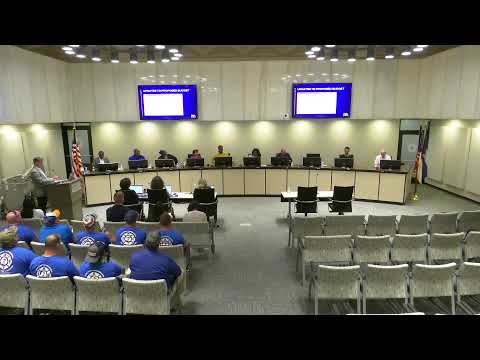
Mayor Cyril Jefferson convened a special meeting of the High Point City Council and, after presentations and lengthy debate, the council adopted an updated fiscal-year budget that asks staff to include a Special Separation Allowance (SSA) for firefighters within the approved plan.
Budget and Performance Director Steven Harvel Luke told the council that North Carolina Senate Bill 889, a reappraisal moratorium signed by the governor on June 19, reduced High Point’s taxable valuation from about $19.5 billion (with reappraisals) to roughly $14.5 billion under the moratorium scenario. Luke said the change created a general-fund gap of a little more than $12.5 million and that, without other modifications, the updated proposed tax rate would be 73.49 cents — an increase of about 8.74 cents over the current 64.75-cent rate.
Council discussion focused on how to fund an SSA for firefighters — a benefit intended to keep public-safety recruitment and retention competitive with nearby cities. Luke gave staff estimates (not an actuarial analysis) projecting SSA costs if implemented Jan. 1, 2027: about $111,000 in FY27, rising to an estimated $718,000 by FY31 as participation accrues. Councilmembers cited comparisons to other municipalities: Gastonia was cited in staff materials at roughly $1 million per year; Greensboro recently approved SSA at a higher rate.
Some members pressed to raise the proposed tax rate slightly — by 0.21 cents (producing a higher rate cited in discussion as roughly 73.70 cents) — to create clear, up-front funding for SSA. Others urged fiscal prudence and recommended that staff "find it" in the budget (reallocations or savings) or await actuarial results before locking in a higher rate. Councilmember McKeever said she was not ready to adopt SSA without additional data; several other members said they supported SSA in principle but were concerned about timing and the uncertainty caused by the pending constitutional amendment on the November ballot that could limit future levy growth.
Mayor Jefferson summarized the options and put a compromise motion to the council: approve the budget with the 8.74-cent increase as presented and direct staff to identify funding within the adopted budget to include the SSA. A substitute motion to increase the rate by 0.21 failed on a split vote. The council ultimately approved the compromise motion 5-3. The motion directed staff to "find" a way to include SSA within the adopted budget rather than immediately increasing the tax rate beyond the 8.74-cent plan.
Council members emphasized that details of any SSA program — eligibility, age limits, and precise benefit structure — will be designed later; staff said the council had asked the city’s CPA to perform an actuarial analysis, but a schedule and cost for that work had not yet been finalized. Multiple councilmembers also noted trade-offs in the budget: staff cautioned that some items under consideration are recurring or tied to safety recommendations (for example, three fire safety training officer positions recommended to provide one per shift) and that cutting recurring operational items to fund SSA could have long-term consequences.
The council also approved three related budget items earlier in the meeting: the annual budget ordinances for Forward High Point (doing business as Downtown High Point), the High Point Market Authority, and Visit High Point (the convention and visitors bureau). Mayor Pro Tem Monica Peters recused herself from the Visit High Point vote. Those votes were recorded by voice and carried as presented.
The council adjourned after adopting the budget and instructing staff to return with implementation details and the actuarial work needed to finalize SSA program design.