Get Full Government Meeting Transcripts, Videos, & Alerts Forever!
Get email alerts on the Surveys Research topic
No spam. Unsubscribe anytime.
District pulse surveys show steady overall ratings but a significant drop in perceived student-discipline effectiveness
Summary
PLCS presented results from seven short, targeted 'pulse' surveys showing generally positive perceptions but a sharp decline in the share of respondents who agree student discipline is maintained effectively (from ~70% in 2021 to ~45% in 2026); administrators proposed changes to survey cadence and an annual baseline instrument to improve reliability and actionability.
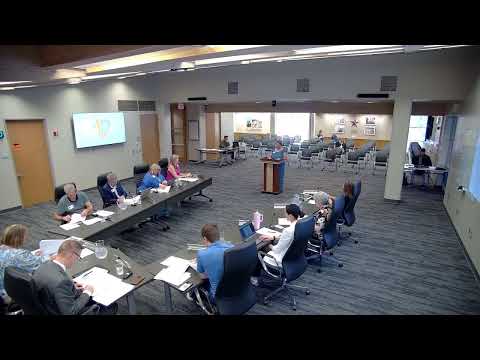
Dr. Christopher Villarreal presented the first-year results of the Papillion-La Vista Community Schools 'Pulse Survey' model on June 22, describing a series of seven short, topic-focused surveys delivered through the Rickly Recap newsletter and tied to the district's strategic-plan goals.
Villarreal said the district distributed seven surveys from October through the spring that were three—five questions each and provided a two-week cycle from distribution to summarized results. The model generated 10,898 total responses over the year but a lower average response per survey (about 1,557) compared with an average of 4,409 in prior years, which limits confidence when disaggregating results at the building level.
On trend data, Villarreal highlighted that metrics for student accomplishment and student learning remained relatively steady, but responses to the item "student discipline is maintained effectively" showed a notable dip: the highest recorded value in the series was roughly 70% (2021) and the lowest in 2026 was about 45%. "That was one that we discussed with our administrators at our end-of-year retreat," Villarreal said, and the district plans to investigate both survey phrasing and underlying conditions in schools.
Villarreal identified several gaps: lower per-survey response rates versus earlier multi-year instruments, a lack of a single annual baseline instrument to track long-term trends, timing misalignment between action teams and implementation teams that limited immediate actionability for some survey results, and practical distribution limits caused by unique respondent links.
To address these issues, he proposed adding a short annual baseline survey of 10—15 items that would include historical items for year-over-year comparisons, reconsidering the number and cadence of pulse surveys, and using targeted surveys for specific audiences (the presenter cited an example in which a targeted middle-school busing survey produced a 75% response rate). He also proposed closer coordination with implementation teams to ensure results lead to identifiable actions and that summaries of actions be shared with respondents to build trust and increase future participation.
Board members discussed the discipline finding and noted that anecdotal concerns heard by board members generally align with the survey result; administrators said the item had one of the lower parent/guardian response rates, and they plan to rework the question and collection approach to produce more reliable building-level measures.
The board praised the initial rollout and asked administration to refine cadence, improve actionability, and add a baseline instrument in the coming year.