Get Full Government Meeting Transcripts, Videos, & Alerts Forever!
Get email alerts on the Transportation topic
No spam. Unsubscribe anytime.
Burlington council advances Mason Road speed-limit change after engineering study
Summary
The council gave preliminary adoption of a second-reading ordinance amending Chapter 73 to reconcile school-zone timing and set most of Mason Road to 30 mph (except S-curves) after a McClure speed study and historical 2015 data; final signage and enforcement follow engineering and administrative steps.
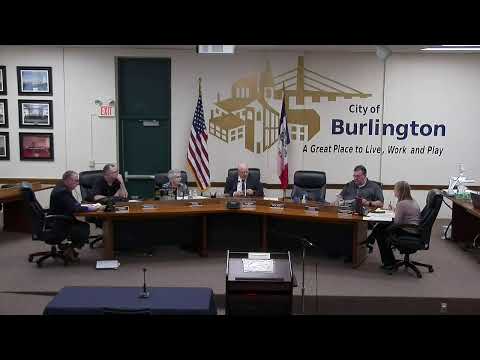
The Burlington City Council voted unanimously Feb. 17 to preliminarily adopt the second reading of an ordinance amending Chapter 73 (speed regulations) to align school-zone hours and to change most of the Mason Road corridor to a 30 mph speed limit, leaving lower limits in the S-curve areas.
Nick, deputy city manager for public works, told the council the packet includes a recent speed study by McClure and prior counts from 2015. He said the studies show 85th‑percentile speeds near 33 mph in portions of the corridor and that the engineering conclusion supports keeping the roadway corridor at 30 mph except where S-curves require different signage. "We are justified in making the whole corridor other than the S-curves 30 mph," he said, and added that the school-zone timing will be changed in ordinance and on signage to read 7:30 a.m. to 4:30 p.m.
The change responds to council and staff goals of consistent signage and enforceable speeds along arterial corridors. A resident who recalled extensive neighborhood design meetings when the road was constructed urged sensitivity to earlier neighborhood requests that some stretches remain as low as 25 mph; council members discussed trade-offs between consistent limits and localized safety concerns. Councilors also noted that raising a posted speed requires stronger engineering justification than lowering it.
The council recorded a unanimous voice vote in favor (Councilors Kryer, Scott, Weiss and Phillips). Next steps include finalizing ordinance language, updating signage, and any required follow-up engineering or public‑works implementation. The council treated the item as a preliminary adoption of the second reading; any final adoption or administrative steps required by ordinance will follow the city’s standard legislative process.