Get Full Government Meeting Transcripts, Videos, & Alerts Forever!
Get email alerts on the Data Centers topic
No spam. Unsubscribe anytime.
Norman imposes one‑year moratorium on large data centers to study water, power and zoning impacts
Summary
The Norman City Council unanimously adopted a one‑year moratorium (with emergency clause) on large data centers on June 23, 2026, directing staff to study likely impacts on the city’s water supply, electricity grid, air emissions, and siting rules and to propose regulations.
The Norman City Council voted unanimously on June 23 to adopt a temporary moratorium, effective immediately, on the permitting, approval or establishment of larger data center facilities within the city while staff completes a study of their potential impacts.
City Attorney Nighton told the council the ordinance was drafted narrowly to capture larger, resource‑intensive data centers while not unintentionally prohibiting small internal server rooms used by local businesses. "We wanted to be careful to not prohibit smaller internal operations that are not the large facilities we're concerned about," the attorney said, explaining the ordinance scope and the one‑year time limit set for the study.
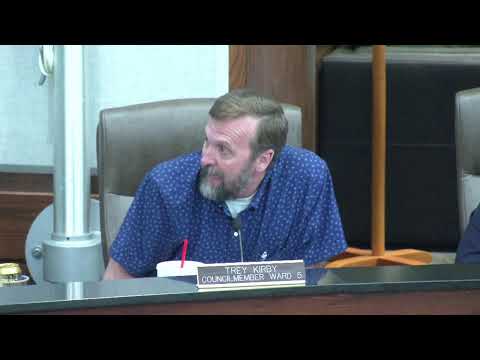
Council discussion emphasized concerns about water and energy consumption, noise and local control. Council Member Kirby, who had advocated for the moratorium in prior study sessions, warned that large facilities can consume substantial water even with closed‑loop systems and may produce community impacts beyond utility use. "We have seen data centers that use billions of gallons of water annually; we need to understand the local implications," Kirby said.
Public commenters echoed both caution and nuance. Industry and IT workers urged careful, technically informed standards rather than blanket bans; environmental and neighborhood speakers urged strict limits and protections for natural resources and community health.
Council adopted the moratorium and an emergency clause to make it effective immediately; staff was directed to collect technical data and return with recommended zoning, permitting language and possible mitigation measures before the moratorium expires (ordinance includes an expiration date about one year from enactment). Council members said the research will look for regulatory approaches that reduce risk of judicial challenge or state preemption while protecting city resources.
Next steps: City staff to study water, electricity and air‑quality impacts, consult utility providers and fire officials, and return with model ordinance language and recommended siting criteria; councilmembers signaled committee review and further public engagement would follow.