Get Full Government Meeting Transcripts, Videos, & Alerts Forever!
Get email alerts on the Care Coordination topic
No spam. Unsubscribe anytime.
Douglas County highlights "Familiar Faces" care‑coordination gains, seeks budget space for a new real‑time platform
Summary
County staff told commissioners that the multi‑agency "Familiar Faces" effort using the MyRC data platform has expanded partner access and produced measurable reductions for some high‑utilizers, but officials said MyRC's retrospective design, privacy rules and facility limits mean the county may seek budget capacity to move to a real‑time care‑coordination platform.
Douglas County staff on June 24 presented progress on the county's "Familiar Faces" care‑coordination work, saying cross‑sector weekly huddles and expanded data sharing through the MyRC platform have reduced emergency‑service use for some of the community's highest‑utilizers while exposing gaps that may require additional county funding and policy work.
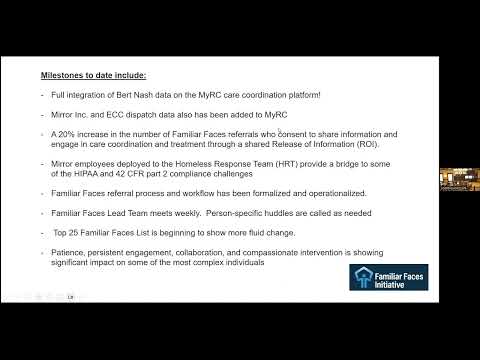
"MyRC now has the full integration of all our behavioral health partners, including Bert Nash," said Bob Triansky, the county's director of behavioral health projects, describing recent go‑lives and data uploads from SUD partners, dispatch and behavioral health providers. Triansky said MyRC contains a partition for 42 CFR‑covered entities to share sensitive information while meeting privacy rules.
Why it matters: county staff said the initiative targets a small number of people who account for outsized emergency‑service use. Triansky described a weekly list of about 20–25 "familiar faces" that the multi‑agency huddle prioritizes; he and partners said about 120–140 unique individuals cycle onto that list each year. "If we can focus like a laser on that smaller group of people and make progress for them, all of this will be worth it," Triansky said.
Evidence of impact: Triansky described one case, identified in the presentation as "Justin," who previously accounted for very high system use. "So far in 2026, this person has one ED visit. They have one ambulance run. They've been to the TRC five times ... and they are now permanently housed and sober," Triansky said, attributing the outcome to persistent, multi‑partner engagement rather than a single intervention.
Limits and next steps: presenters cautioned MyRC is largely retrospective and cannot close referral loops or host secure, longitudinal case notes. County EMS and partner staff said they have been evaluating real‑time care‑coordination platforms (the vendor cited in the session was described as "Gelata/Gelato") and that a full conversion could take more than a year and require new agreements and budget space. Triansky said there is a request in budget supplementals to hold capacity for potential platform work.
Privacy and partners: commissioners pressed staff on payer participation. Staff acknowledged managed care organizations are generally not part of the weekly huddles because of HIPAA and 42 CFR constraints and differing data‑use agreements; staff said case conferences with payers occur outside the constrained huddle when appropriate.
What remains unresolved: presenters and partners flagged service‑capacity gaps that limit what coordination alone can achieve — notably shortages of medical respite, residential nursing options and rapid barrier‑reduction funds for uninsured people. Staff proposed follow‑up work on funding options, regulatory constraints and vendor evaluations and asked commissioners for guidance on which topics to bring back.
The work session recessed with staff asking commissioners whether they wanted more detail on regulatory barriers, funding options and vendor assessments; commissioners said they would continue the conversation in future meetings.