Get Full Government Meeting Transcripts, Videos, & Alerts Forever!
Get email alerts on the Housing topic
No spam. Unsubscribe anytime.
Groton officials present three 'missing middle' tools and ask public for feedback
Summary
At a final public meeting for the "Meeting in the Middle" project, Groton planning staff and a presenter outlined three policy options — maximizing IRC allowances, permitting parent–child lot subdivisions, and incentivizing smaller multiunit buildings — to expand housing choices; staff will compile public feedback for Planning & Zoning review this fall.
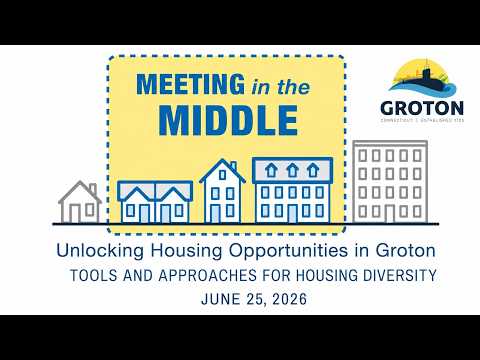
Groton planning director John Reiner and presenter Jeff Davis outlined three potential tools to promote "missing middle" housing during the final public meeting of the town's "Meeting in the Middle" project on the evening of the presentation.
"This being our third and final meeting of this project," John Reiner said, "we're going to start meeting with our Planning and Zoning Commission to start talking about recommendations of ways of how we could actually implement this project." Reiner emphasized that the concepts discussed were ideas, not adopted policy.
Davis, who led the presentation, said the project responds to a local housing shortage. He said the town has produced a regional housing-demand study, housing typologies and opportunity-site tests, and conducted public outreach including walking tours and a spring survey with just over 120 responses. "On a scale of 1 to 10, how well do you think Groton's housing needs are being met?" he asked, noting that roughly 75% of respondents were on the lower half (1–5) of that scale.
Davis described three concepts staff want public feedback on: maximizing the International Residential Code (IRC) to allow smaller, wood-frame homes (for example, two-family homes plus accessory dwelling units) with lower costs and faster approvals; parent–child lot subdivisions (PCLs), which would divide a larger "parent" lot into smaller legal "child" lots to enable individually owned small homes without condominium conversion; and incentives and regulatory adjustments to encourage smaller-scale multiunit buildings (roughly five to 12 units) where multiunit development is already allowed.
Davis said maximizing the IRC is intended to make small-scale development "easier, faster, cheaper and more likely to get built" by applying clearer construction standards and making projects more accessible to local builders. On PCLs, he said the approach keeps overall parent-lot dimensional standards while allowing child lots to have reduced minimum lot sizes and other more flexible rules; utility and permit approaches could be tailored, and subdivisions could be recorded before, during or after development. For smaller-scale multifamily, Davis proposed a menu of options including separate dimensional standards for small buildings, scaled stormwater requirements, reduced amenity mandates, administrative review pathways, and targeted tax or fee incentives.
Speakers noted common community concerns raised through the outreach: potential increases in traffic and school enrollments, loss of green space or neighborhood character, and the need for design standards. Davis summarized survey support: 52% of respondents said missing-middle housing could be a solution, 25% said "yes, but" (support with conditions), and 11% were not supportive.
On parking, Davis said towns can require parking but cannot deny a proposal for fewer than 17 homes solely because the applicant cannot meet parking requirements, citing a recent change in state law. He suggested options such as requiring onsite parking, allowing some street parking, or neighborhood parking permits.
Davis said the Planning & Zoning Commission will consider options in the fall after staff compiles feedback. He reminded attendees of an upcoming walking tour on July 16 (starting location to be announced) and an online survey expected to post Monday; staff plans to present a final report in December. The meeting then moved to an open-house format with five staffed stations for feedback.