Get Full Government Meeting Transcripts, Videos, & Alerts Forever!
Get email alerts on the Land Use topic
No spam. Unsubscribe anytime.
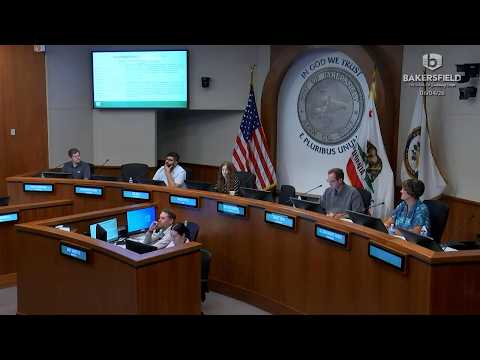
Bakersfield Planning Commission approves 313‑lot Vesting Tentative Tract Map 7451 after mitigated negative declaration
Summary
The Planning Commission on June 4 adopted a mitigated negative declaration and approved vesting tentative tract map 7451, permitting a 313‑lot subdivision on 40.77 acres in northwest Bakersfield after staff and applicant presentations and no public opposition.
The City of Bakersfield Planning Commission on June 4 approved a mitigated negative declaration and vested tentative tract map 7451, clearing the way for a proposed subdivision that would divide 40.77 acres in northwest Bakersfield into 313 single‑family lots, one park lot and a multi‑use trail.
Associate Planner Veronica Martinez presented staff’s recommendation to adopt the mitigated negative declaration and approve the tract map, saying the project complies with the California Environmental Quality Act with mitigation measures for air quality, biological resources, cultural resources and traffic. Martinez summarized the proposal’s lot sizes — ranging from about 3,440 to 3,600 square feet — and access from Forage Way and Poplar Spring Avenue.
The developer and technical consultants emphasized greenhouse‑gas and air quality mitigation. Blaine Neptune of McIntosh and Associates said Vesting Tentative Tract 7451 “is consistent with the general plan and the housing element. It will provide much needed housing.” Whitney Jackson of Trinity Consultants told the commission the applicant has committed to an all‑electric development with no natural gas connections, photovoltaic systems, EV charging infrastructure and verified carbon‑credit purchases to offset lifecycle emissions to net zero. Jackson said, referring to modeled results, that the measures and offsets would produce a “22.6% decrease in the project's total greenhouse gas emissions” from certain measures and reported a modeled excess cancer risk of 0.58 in one million and a chronic hazard index of 0.00034 — both below San Joaquin Valley Air Pollution Control District thresholds.
Biologist Steve Pruett said field studies followed California Department of Fish and Wildlife and U.S. Fish and Wildlife Service guidelines and described proposed on‑site enhancements intended to benefit special‑status species such as the kit fox. Pruett also said the applicant is in early consultation to establish a 500‑acre private habitat conservation bank that would serve as a partial offset for potential impacts; he clarified the bank “is not tied to this specific project.”
Tom Dee, representing the applicant, said the project record and mitigation commitments have addressed opposition letters submitted to the record, and Mike Petrini, vice president of land for D.R. Horton, said the project would create smaller, entry‑level lots for first‑time homebuyers in an area that has not seen that product type in about a decade.
No members of the public spoke in opposition at the hearing. After commissioners asked clarifying questions — including whether the proposed conservation bank is directly tied to the tract map — the commission moved to adopt the mitigated negative declaration and approve vesting tentative tract map 7451. The clerk announced the motion passed; Vice Chair Martin and Commissioner Core were absent for the vote.
What happens next: staff and the applicant will proceed with the project approvals and conditions as adopted; the record includes the mitigations described in the staff report and the project’s enforceable conditions. The commission also received notice that two environmental impact reports and a general plan update document will be released this summer for future review.