Get Full Government Meeting Transcripts, Videos, & Alerts Forever!
Get email alerts on the Budget topic
No spam. Unsubscribe anytime.
Bakersfield budget hearing spotlights surveillance, tree canopy and rescue‑unit cuts as residents press council
Summary
At a June 10 public hearing on the proposed FY2026–27 budget, residents urged the council to halt expansion of Flock Safety surveillance, preserve fire rescue positions and fund community priorities including a $3 million allocation for MLK Park and an expanded tree‑planting program. Staff said a privacy policy is under DOJ review and that budget adoption is scheduled for June 24.
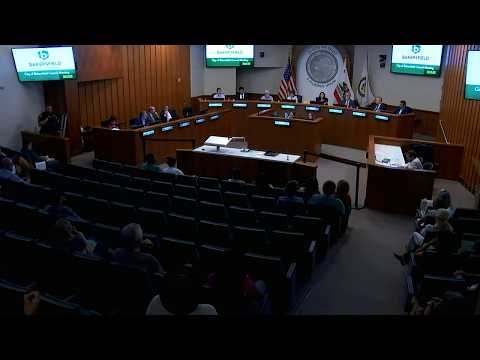
The Bakersfield City Council on June 10 opened a public hearing on its proposed FY2026–27 budget and faced sustained public pressure over surveillance cameras, tree canopy gaps and potential cuts to emergency response staffing.
City Manager Christian Klay and Finance Director Randy McKean presented a balanced proposed budget with roughly $441 million in revenues and described a multi‑year restructuring that includes elimination of 72 vacant positions to realize about $9.4 million in savings. Residents used the hearing to press elected officials on several community priorities and to demand more transparency about city programs.
Why it matters: The budget sets near‑term priorities for public safety, infrastructure and community services. Public testimony singled out (1) the city’s contract with Flock Safety and an expanding license‑plate camera network, (2) the possible loss of medical rescue units in the fire department, and (3) tree canopy and park investments — notably the proposed $3 million for Martin Luther King Jr. Park renovation that community advocates say is essential for East Bakersfield.
Surveillance and transparency
Several speakers urged the council to pause or rescind the city’s use of automated license‑plate reader systems operated through a vendor known as Flock Safety. “Halt the expansion and end the contract,” said Jason Cper, who described obtaining public records showing more than 130 cameras and raised concerns about audit and public‑notice practices. Ariel Dyer, a librarian who testified she grew up in Bakersfield, said the emphasis should be on housing, health and community services rather than “surveillance theater.”
City staff responded that a privacy and accountability policy for camera use has been drafted, has been reviewed by the police department’s advisory panels and the Department of Justice, and will be taken to the Safe and Healthy Neighborhoods committee for public review (staff estimated committee review in August). City Manager Christian Klay said the policy work is intended to establish usage limits and reporting before further expansion.
Staffing, vacancy reporting and rescue units
The budget presentation included required vacancy reporting under AB 2561 (2024). Human Resources Director Christy Tenter said the city’s point‑in‑time vacancies rose to roughly 200 from earlier counts because of a hiring freeze and active recruitments, and outlined retention measures including market pay adjustments.
Council members and some speakers pressed staff on alternatives to eliminating six vacant fire positions that would mothball rescue apparatus. Finance Director McKean and staff offered four options to close a roughly $900,000 gap linked to those positions — using the proposed capital contingency, reallocating CIP projects, drawing down available fund balance created by hiring freezes, or accessing the rainy‑day reserve — and said the council could act before final adoption.
Chief Albertson described the city’s rescue units as two‑person apparatus specialized for rapid medical response in high‑call stations; he said the rescues reduce response times during concurrent calls and that removing them would shift those responses to more distant apparatus and could increase response times on medically urgent calls.
Parks, trees and MLK Park
Tree advocates and environmental groups said Bakersfield’s street‑tree cover is unequally distributed by neighborhood and called for a formal planting plan, heritage‑tree protections, and an active inventory program. Staff said the city planted 1,225 trees in 2025 and had planted another 708 so far in 2026, and that new planting pallets, ANSI A300 pruning standards and arborist review procedures were already in place.
Several speakers urged the council to keep the $3 million MLK Park renovation line in the budget; Councilmember Gonzalez confirmed the $3 million allocation remained in the staff recommendation.
Next steps
City staff said the proposed budget will return for adoption at the council’s June 24 meeting and that councilmembers may propose amendments before that vote. Staff also committed to present the camera‑use policy to the appropriate committee and to continue dialogue with community groups on trees and public‑safety staffing.
The public hearing provided multiple paths for follow‑up: further council direction on the rescue positions, a procedural timeline for the surveillance policy and an opportunity to allocate contingency or CIP funds to tree and park priorities before final budget adoption.