Get Full Government Meeting Transcripts, Videos, & Alerts Forever!
Get email alerts on the Land Use Zoning topic
No spam. Unsubscribe anytime.
County approves solar-farm standards and Speed community overlay; rules take effect July 1
Summary
The Edgecombe County Board of Commissioners adopted UDO TA7-26 on June 22, 2026, approving new solar farm standards (including setbacks, screening and annual inspections) and applying county zoning plus a Speed community overlay to parcels in the dissolved town of Speed; the measures become effective July 1.
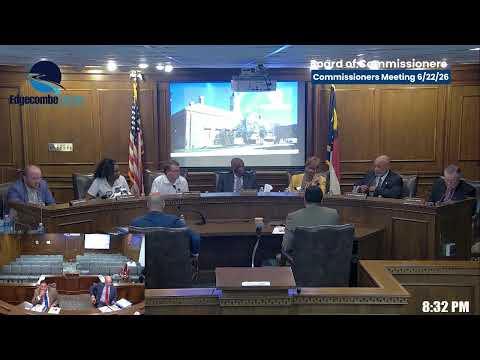
The Edgecombe County Board of Commissioners on June 22 adopted a text amendment to the county’s Unified Development Ordinance that creates new standards for large solar facilities and applies county zoning — including a new Speed community overlay — to parcels formerly under the town of Speed’s jurisdiction.
County staff presented UDOTA 7/126 as two related updates: (1) detailed standards for utility-scale “level four” solar systems (described in the presentation as facilities at or above 2 megawatts, often with battery storage or a dedicated substation) and (2) a Speed community overlay to preserve existing uses and development potential inside the territory of the dissolved town of Speed. Chad Meadows, a county planner, told the board that the level-four standards set rules for permitted districts (business, industrial, or planned development), establish a 300-foot minimum setback from residential districts for level-four facilities, require a 35-foot-wide perimeter buffer with three rows of vegetation, and cap battery‑storage noise at 45 decibels after 7 p.m. He also described an annual third‑party site inspection and permit renewal process that can lead to permit nonrenewal and enforcement if a facility fails to maintain required screening or other conditions.
Meadows said the new level-four use will be permitted only through conditional zoning and a development agreement so the county can negotiate mitigation, public-benefit measures and oversight. The presentation also clarified that existing level‑two and level‑three systems are carried forward under state law and are grandfathered unless they expand, in which case some new standards may apply.
On the Speed overlay, staff said the county’s approach was driven by recent state downzoning restrictions (session law 2024‑57). The overlay preserves 16 uses that were allowed in Speed’s ordinance so the county will not reduce the range of allowable uses without consent, while applying the county’s development standards to new development outside the overlay. Staff explained three options for property owners who seek to change existing development — variance, conditional zoning, or a nonconforming authorization procedure — and noted the planning board’s unanimous recommendation in May.
During public comment, residents raised transition issues for Speed, most notably who will pay for street lights after dissolution. Vernell Jordan told commissioners that asking individual property owners to assume street‑light bills would create a public‑safety risk and urged the county to adopt a permanent plan to maintain lighting rather than shifting costs to residents. County staff acknowledged the concern and said they would return with options, noting the county does not currently fund street lights outside county property.
After reading a formal statement of consistency with the county’s 2014–2034 comprehensive plan, the board adopted the resolution of intent to apply county zoning and the Speed community overlay to parcels in the former town of Speed. The resolution, which the board tied to case UDO TA7‑26, sets the changes to become effective July 1, 2026.
What happens next: The county will implement the listed permit and inspection processes for future level‑four solar applications; property owners in Speed who want to request different zoning or to develop will be advised to work with planning staff on variance, conditional‑zoning, or nonconforming authorization procedures.
Sources: presentation and public hearing read by Mr. Peters; planner Chad Meadows’ presentation and the board’s adoption of the resolution on June 22, 2026.