Get Full Government Meeting Transcripts, Videos, & Alerts Forever!
Get email alerts on the Land Use Data Centers topic
No spam. Unsubscribe anytime.
East Fishkill board imposes three-year moratorium on data centers after large public turnout
Summary
After a packed public hearing during which residents raised water, noise, and environmental concerns, the East Fishkill Town Board adopted a three-year moratorium on data-center construction and a seven-month extension of an industrial moratorium, and created a task force to study impacts and zoning changes.
The East Fishkill Town Board on June 25 adopted a local law placing a three-year moratorium on data-center construction in the town and a seven-month extension of an industrial moratorium after a lengthy public hearing that drew dozens of residents and regional speakers.
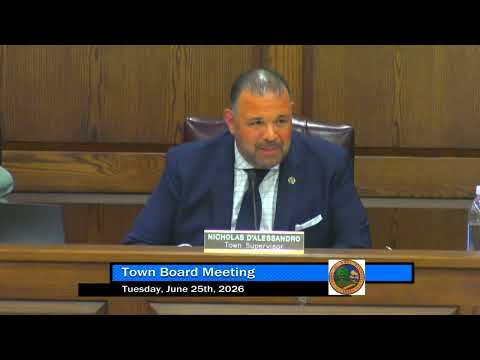
Supervisor D'Alessandro opened the hearing by saying the pause was intended to let the town "review everything" and hear from residents and experts: "A moratorium gives us time. It gives us a time out for us to say, 'Let's review everything.'" He said the board is seeking durable policies to balance economic development with community character and infrastructure needs.
More than 80 people addressed the board in a multi-hour public-comment period. Speakers repeatedly raised concerns about groundwater and private wells, potential contamination on previously industrialized parcels such as iPark, noise (including low-frequency hum), light pollution, and the scale of electricity demand. Several residents cited experience with IBM-era contamination and urged stronger environmental safeguards and financial protections. Carrie Peterson, one of the earliest speakers, said the siting of large, energy-intensive facilities "must be evaluated not in isolation, but as part of a broader pattern" and urged the town to consider impacts on nearby homes, preschools, animal-care facilities, and places of worship.
Other commenters pressed the board to extend the moratorium beyond three years; legal counsel at the hearing explained that municipal moratoria must have a specific purpose and be reasonably tailored in duration to survive judicial review. The town attorney and board members said the purpose of the moratorium is to complete studies, close zoning loopholes, and craft enforceable local rules while recognizing that state or federal actions can preempt local law.
Following public comment, the board closed the hearing and approved the two local-law motions by voice vote; five members were present for the votes. The board also voted to establish a data-center study task force to include residents, town officials, engineers, utility representatives and environmental professionals to examine infrastructure capacity, environmental review, noise and light mitigation, fiscal impacts, and zoning or local-law options during the moratorium.
Council members and regional advocates emphasized the task force will pursue an evidence-based record. Councilwoman Flores said the moratorium should be used to require that any future industrial application "be subject to a robust environmental review" including air, water, noise and waste management analysis, and to consider financial mechanisms so developers do not shift infrastructure costs to ratepayers.
The town made other related clarifications during the meeting: some speakers noted that New York State has been considering a one-year moratorium and that state bodies such as the Public Service Commission (PSC), DEC, and the Office of Renewable Energy Siting (ORES) may have overlapping authority. Board members said the local moratorium is intended to buy time to build the town's own technical record and, if appropriate, adopt local regulations that can be defended in court.
The board said the task force will be assembled during the moratorium and will aim to complete substantive work and provide recommendations on whether to extend, amend or allow applications after the pause. The board also asked staff to retain outside planning, environmental and engineering consultants as needed to support the task force's work.
The moratorium and the task-force resolution were passed at the meeting's conclusion. The board set its next regular meeting for July 23, 2026, and encouraged residents to participate in the task force process and in public meetings.
What happens next: the moratorium is intended to pause certain development approvals while the task force and town staff perform studies and draft potential local-law changes; state or federal actions could alter the local timeline. The town emphasized the pause is a process to gather facts and to propose enforceable local measures rather than an immediate prohibition on all industrial use of land.