Get Full Government Meeting Transcripts, Videos, & Alerts Forever!
Get email alerts on the Cannabis Regulation topic
No spam. Unsubscribe anytime.
Grant City Council adopts cannabis and hemp business ordinance after public hearing
Summary
After a staff presentation and council questions about acreage, screening and enforcement, the Grant City Council approved a cannabis and hemp business registration and zoning ordinance (packet reference 2024-D82); staff said state rules may require future amendments.
Grant City — The Grant City Council approved a draft ordinance establishing a city registration and zoning framework for cannabis and hemp businesses after a staff presentation and a short public hearing.
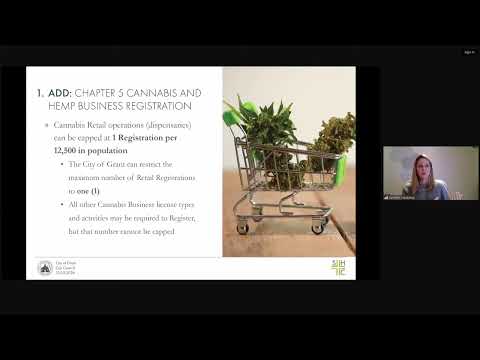
Jennifer, a city staff member who led the presentation, told the council the draft separates a city registration process from state licensing and mirrors state use types in local zoning. She said “all cannabis and hemp based businesses must register” with the city and explained the draft proposes capping retail dispensaries at one retail registration based on the population rounding rule tied to a 12,500 threshold.
The ordinance creates two parallel pieces of code: a registration section (to track businesses and require a certificate of compliance where appropriate) and zoning amendments that define uses such as cultivation, retail dispensary, manufacturing, laboratory, wholesale distribution and storage. Jennifer said state rules are not yet finalized and the city will likely need to adjust the local ordinance once Minnesota issues its licensing rules.
Council members questioned several operational points. Council member John asked, “is 20 acres the right size for a business like this or should it be 40 with all the buffers that we have in place and plus the security,” raising concerns that 20 acres may not be sufficient given setbacks and screening needs. Staff replied the 20‑acre figure was chosen to mirror similar land‑use standards the city applies to comparable agricultural or agritourism businesses but that the council could consider changing the number if it has a defensible reason.
Members also pressed how screening requirements would be enforced for outdoor cultivation (plants that can reach 10–12 feet tall) and who would perform compliance checks. Staff said security plans, camera requirements and odor‑mitigation measures will be part of the state licensing process; the city’s role will focus on land‑use controls (setbacks, buffering, certificates of compliance) and on coordinating who conducts age‑verification compliance checks, a function some counties, sheriff’s offices or nonprofit contractors have provided elsewhere.
The draft imposes maximum buffer setbacks the state allows — for example, a 1,000‑foot buffer from schools and a 500‑foot buffer from residential treatment facilities — and calls for separation between cannabis businesses to avoid clustering. Staff’s mapping analysis showed the proposed buffers would exclude several properties near the local school campus and some behavioral‑health facilities.
During the public hearing a resident praised the staff presentation and expressed no opposition; no virtual attendees indicated a desire to speak. The council moved to close the hearing and then voted to approve the ordinance as presented (packet reference 2024‑D82). The vote was recorded by roll call and announced in the meeting as affirmative by the council members present.
The council also approved a companion resolution authorizing summary publication of the ordinance rather than publishing the full text. Staff said the ordinance will likely return for technical amendments once Minnesota finalizes rule language and that the city will refine its fee schedule and any performance standards in January.