Get Full Government Meeting Transcripts, Videos, & Alerts Forever!
Get email alerts on the Municipal Budgeting topic
No spam. Unsubscribe anytime.
Waterford selectmen approve FY27 budgets after targeted amendments
Summary
The Board of Selectmen approved FY27 operating, capital and debt budgets, including the insurance budget and amended retirement commission totals, after targeted reductions and line‑item adjustments. Officials also authorized forwarding the five‑year CIP to the board of finance and RTM.
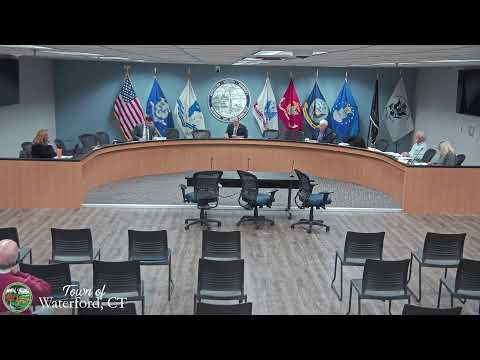
The Waterford Board of Selectmen voted to approve several fiscal year 2027 budget measures, including the insurance request and an amended retirement commission budget, during a regularly scheduled meeting.
The board approved the proposed insurance budget as presented after staff described the drivers of higher costs. Kim, the staff member answering for insurance, said increases in unemployment compensation and deductible coverage were driven by "actual claims and projected claims" and that health insurance is carried through the State Partnership plan administered by Anthem. Budget materials listed the insurance line in the packet as 5,947,16 (notation as provided in the meeting packet). The board took the item by voice vote.
A separate set of votes amended the retirement commission request. The board first approved a small correction to line 51940 (a $6,351 reduction to match backup documentation). Later, after extended discussion about tradeoffs between funding actuarial recommendations for Other Post‑Employment Benefits (OPEB/OPED) and short‑term taxpayer impacts, the board approved a bundled amendment to reduce two retirement line items as proposed by the first selectman; the retirement budget was then re‑posted with the amended total.
Board members repeatedly framed the debate as balancing long‑term liabilities and near‑term tax pressure. One selectman asked whether certain surplus or overbudget lines could be used to soften the impact; another emphasized that some retirement contributions are an investment that accrues interest in a trust. The first selectman acknowledged the fiscal strain on fixed‑income residents and said he would work with the retirement commission on a multiyear plan for contributions.
The meeting also approved the town's capital and debt service totals, and the first selectman was authorized to forward the five‑year Capital Improvement Plan for FY2027–2031 to the board of finance and RTM for further action. The board voted to waive the reading of departmental summaries to expedite the process.
The board adjourned following the final ratification vote. Future budget steps were left to the board of finance and RTM as part of the standard appropriations process.