Get Full Government Meeting Transcripts, Videos, & Alerts Forever!
Get email alerts on the Local Taxes topic
No spam. Unsubscribe anytime.
City attorney outlines choices after Georgia special session, flags limits on LHOST implementation
Summary
City Attorney Joe Allen told Griffin commissioners that a recent Georgia special session expanded a redistricting call to include local sales‑tax measures; he explained differences between LOST and LHOST (Senate Bill 33) and warned cities were caught off guard, citing timing and legal‑risk constraints for a November referendum.
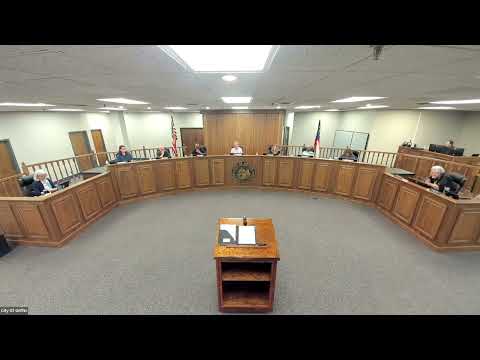
City Attorney Joe Allen briefed the Griffin City Commission on the outcomes of a Georgia special session and what they mean for local sales‑tax options.
Allen said the special session called by Gov. Brian Kemp, originally limited to redistricting, was expanded to include local acts needed to implement a limited homestead exemption sales tax created in the prior legislative session. He identified Senate Bill 33 and House Bill 581 as the measures that reshaped the legal landscape and said the two approaches — a countywide floating local option sales tax (LOST) and the limited homestead exemption sales tax (referred to in discussion as LHOST/ELHOST) — are mutually exclusive: "You can't have a LOST... and also have a LHOST...Same time. You have to have one or the other," Allen said.
Why it matters: the two options split revenue differently and change which taxpayers benefit. Allen said LOST requires counties and cities to negotiate an intergovernmental contract that divides sales‑tax revenues and then put the matter to a referendum; the LHOST approach instead required a local act passed by the General Assembly before a county could call an election under the special session rules.
Allen noted many cities were "a little bit blindsided" by the timing and said local governments that had not prepared bills ahead of the special session had little opportunity to influence the schedule. He said a number of local acts related to LHOST were filed but failed to secure the necessary two‑thirds legislative support during the special session, leaving cities to consider alternatives.
Legal and timing constraints: Allen said Senate Bill 33 may face constitutional challenges — he noted an objection because tax measures traditionally originate in the House — and that litigation risk is a real possibility. He also cautioned that achieving an intergovernmental agreement for a LOST in time for a November referendum would be difficult: the practical cutoff was identified in counsel's remarks as around July 12. Allen said a March ballot in the following year would be the more realistic option in many cases because a successful referendum requires a short lead time before collections could begin (roughly three months after passage).
Local numbers and negotiation dynamics: commissioners and staff discussed a county presentation that modeled distributions under ELHOST and LOST scenarios; the county's projection showed a substantial shift toward the county in at least one model (the city’s projected share under ELHOST was described at roughly 6.517% vs. the county’s 93.227% in that example). Commissioners urged vigilance on the split and said the city should be prepared to respond if the county pursues a LOST after the special session concluded.
Next steps: Allen recommended the commission consider whether to pursue negotiations with the county for a LOST, to prepare for a possible called meeting if the county moves forward, and to request specific data from the county tax commissioner if more precise local projections are needed.
The commission moved on to the scheduled police‑department presentation after asking counsel and staff to keep them apprised of any changes to the legislative timetable.