Get Full Government Meeting Transcripts, Videos, & Alerts Forever!
Get email alerts on the Public Safety topic
No spam. Unsubscribe anytime.
Griffin police outline staffing, training and accreditation gains; commissioners press for policy details
Summary
Police Chief Frank Strickland and command staff briefed the board on staffing levels, CID caseloads and clearance rates, specialized operations and a major policy rewrite tied to CALEA and state accreditation work; commissioners sought more detail on specific policy changes and historical personnel-policy shifts.
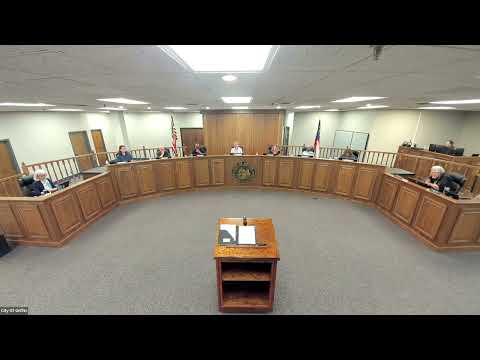
Chief Frank Strickland and members of the Griffin Police Department presented a multi-hour briefing to the City of Griffin Board of Commissioners covering department structure, investigative caseloads, training, accreditation and community programs.
Strickland described the department’s organizational layout — uniform patrol, criminal investigations (CID), operations (OPS) and support units — and provided staffing metrics and vacancy information. Presenters cited roughly 86 authorized sworn positions with about 51 officers assigned to uniform patrol (shift-level staffing discussed); CID and records had several open positions that department leaders said they were actively recruiting to fill.
CID and specialized units provided operational examples and numbers: investigators reported monthly investigator-initiated reports, supplemental reports and arrest/charge tallies for January–May 2026; the department said personal-crime clearance rates exceeded national averages (examples given: 52% personal-crime clearance in 2025 with a rise to 58% in 2026 to date) and described a multi-jurisdictional child-exploitation case that involved federal partners. Investigators also described 'bin flip' operations that recovered vehicles converted to government use and reported roughly $74,785 in cash seizures, about $300,000 in vehicle-value savings and additional seized value of $57,885.32 from operations presented to the board.
Training and professional standards were a major focus. Lieutenant John Kelton summarized annual and required POST training topics (use of force, de-escalation, community policing, human trafficking, firearms and others), the department’s expanded internal instructor base and a new training partnership with the University of North Georgia to deliver in-house certification and advanced classes to other agencies. The department characterized SWAT work as planning- and prevention-focused and said it had not performed any forced-entry operations this year; presenters said most entries are avoided through containment and voluntary surrender.
Cody Zigler, accreditation manager, described a full rewrite of the department’s written directives and a move into PowerDMS: the manual was reorganized into roughly 96 discrete policies (from about 45 prior documents), each with mandatory signoff and tests for higher-liability updates. Zigler said the department has pursued CALEA advanced accreditation and state certification, passed remote assessments with corrective follow-up and expects a CALEA on-site and award process over the coming year; he warned that GCIC audits and CALEA standards require ongoing documentation and that failure to maintain required proofs can result in sanctions.
Commissioners repeatedly asked for a clear, historical summary of what specific policies were changed under prior chiefs and which changes (if any) led to litigation. One commissioner cited an earlier settlement tied to search-and-seizure policy and asked which policies had been rewritten to prevent recurrence; panelists said the policy manual rewrite and accreditation work are intended to address such liabilities and offered to return with a more detailed, itemized chronology of policy changes and who made them.
The presentation also covered community outreach programs: the community center and youth programming were credited with a roughly 50% reduction in calls for service in the immediate area after implementation; the police-affiliated nonprofit used for events was discussed as a fundraising vehicle to support outreach without drawing on the general fund. Fleet maintenance, PIO duties and evidence/property-room volumes (the department said its property/evidence repository contains approximately 60,000 items) were also described.
At the end of the meeting the board thanked the department for the presentation. The board then moved to adjourn; a motion was made, seconded and approved by voice vote.
Quotations
"We don't have to depend on how to say the training center anymore. We can do it in-house," Chief Frank Strickland said, citing the new training and accreditation partnerships.
"I think your team has done an exceptional job today presenting what they're doing," Commissioner Ward said in closing remarks.
Next steps: department staff offered to provide the board a targeted memo listing specific historical policy changes and the records that document them, and commissioners requested that follow-up detail before any policy votes or litigation-related payouts are considered.