Get Full Government Meeting Transcripts, Videos, & Alerts Forever!
Get email alerts on the Prop 218 topic
No spam. Unsubscribe anytime.
Lancaster council OKs resolution letting city manager cast ballots for city parcels as residents press questions about Prop 218 costs
Summary
Council approved a resolution allowing the city manager to vote on Prop 218 assessments for city-owned parcels while residents at the meeting pressed staff for parcel-specific cost details and raised concerns about fee increases and outreach ahead of the July 14 balloting.
Lancaster City Council voted to authorize the city manager to cast ballots on behalf of city-owned parcels in upcoming Proposition 218 assessment ballots for lighting, maintenance, sewer and drainage, a move staff said ensures the city’s property interests are represented in the July 14 balloting. The resolution passed with Councilmember Rocio Castellanos voting no.
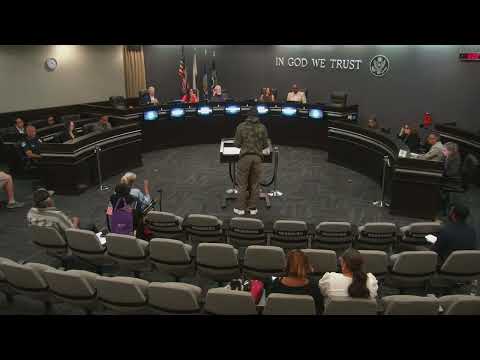
The vote followed an extended public-comment period in which residents asked how the assessments are calculated, whether the public can observe the ballot count and whether property owners — especially seniors and fixed-income households — will bear disproportionate cost increases. Arthur Callaway, a Lancaster resident who spoke during public comment, urged others to “say no on new taxes,” saying the mailed ballots and the supporting materials left him with unanswered questions.
Staff told the council and speakers the Proposition 218 balloting and the subsequent tabulation would be done in a publicly accessible location (likely council chambers after the meeting on July 14) and explained how sewer and other assessments are calculated. According to staff, engineers do not measure household effluent individually; instead they use an equivalent dwelling unit (EDU) methodology and assignment tables to allocate fees parcel by parcel. As staff put it during the meeting, the engineers’ report “does do a calculation of what’s called an equivalent dwelling unit and assigns those to properties based on a formula,” a process the council said is explained in the packet and related engineering documents.
Council members and residents pressed for clearer, parcel-specific information. Speakers asked for a simple worksheet that would show a homeowner how much their parcel would be charged and whether tiering or phased increases for low-income households could be implemented. Staff and council pointed to open-house outreach sessions held in recent weeks and said supporting documents and the engineers’ report are posted online; they also agreed to provide additional outreach and one-on-one assistance for residents who request parcel-level explanations.
With the tallying scheduled for July 14 and ballots already in circulation, councilmembers emphasized the public can review the balloting in a public place and that staff will continue outreach. The resolution empowers the city manager to cast ballots on city-owned parcels only; it does not change the ballot mechanics for private property owners.
Next steps: the Prop 218 assessment balloting continues, the public hearing item PH2 was continued to July 14, and staff said they will continue outreach and help residents find parcel-specific information before the final count.