Get Full Government Meeting Transcripts, Videos, & Alerts Forever!
Get email alerts on the Governance topic
No spam. Unsubscribe anytime.
Conservation Commission asks planning board to formalize advisory role; staff warns of state-law limits
Summary
The Coventry Conservation Commission asked the Planning Commission to endorse clearer local code allowing ConCom review of certain large projects before Planning Commission action; staff noted state law limits routine pre-review for comprehensive permits but said majors and large subdivisions could be incorporated into a checklist-driven review.
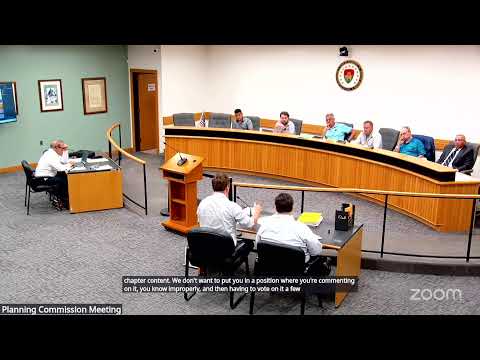
Representatives of Coventry's Conservation Commission urged the Planning Commission on June 22 to seek a change in local code that would give the ConCom a clearer, routine advisory role on major development proposals.
Chair Jerry Narkiewicz and member Tom Pendergast told commissioners that ConCom members have technical expertise — for example on stormwater and habitat issues — and said earlier practice of routing many projects to the ConCom had fallen away. The ConCom's letter and testimony asked that the Planning Commission encourage the Town Council to amend local code so the ConCom can provide advisory comments on certain project classes before planning decisions are finalized.
Planning staff responded that state law constrains pre‑review for comprehensive permits (the statute intends a single decision‑maker and limits extra preconditions that would fragment the process). Staff explained that for comprehensive permits an advisory opinion from another board must be requested by the Planning Commission after the application is submitted; the availability to seek an advisory opinion exists but would affect the statutory review clock unless the applicant agrees to an extension. For majors and certain large subdivisions, staff said the town could use local code and a checklist to capture ConCom review at master‑plan stage without violating state procedural requirements.
Commissioners discussed a practical approach: allow ConCom to flag projects of interest (for example by email or packet note) and permit the Planning Commission to vote to request a formal advisory opinion on a project‑by‑project basis. Staff and commissioners said the Town Council would need to clarify the ConCom's role in code updates if the municipality wants routine pre‑submittal reviews for some project types.
Next steps: staff will carry the Planning Commission's discussion forward to the Town Council as part of code‑update considerations; commissioners signaled support for pursuing a targeted code change that preserves statutory timelines while capturing ConCom expertise where appropriate.