Get Full Government Meeting Transcripts, Videos, & Alerts Forever!
Get email alerts on the Justice Center Project topic
No spam. Unsubscribe anytime.
Public safety committee votes to pursue new horizontal 1,500‑bed justice center at work center
Summary
After a consultant outlined code deficiencies, capacity shortfalls and multi‑million dollar renovation costs at the existing jail campus, the committee voted to pursue a new horizontal 1,500‑bed justice center at the county work center and to authorize property acquisition if needed.
A majority of the Rutherford County Public Safety Committee voted June 22 to pursue a new horizontal 1,500‑bed justice center at the county work center and to authorize property acquisition or condemnation if required, following a consultant presentation that described serious capacity and code issues at the current campus.
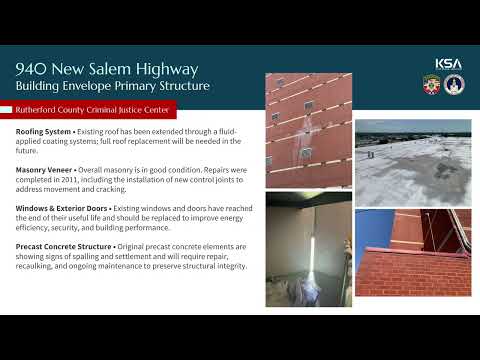
Consultant Bart Klene told the committee the existing justice campus was originally designed for 484 inmates and 88 staff and said the county is “about 350% over capacity,” citing prior studies and the work of a jail committee that has been active for more than two years. Klene described structural, life‑safety and operational problems: precast panels and roofing in need of replacement, non‑compliant evidence storage buildings, mechanical and plumbing systems nearing the end of their useful life, unreliable elevators and outdated detention control systems.
Klene gave order‑of‑magnitude figures for two broad options. Renovating and expanding the existing campus to a 1,500‑bed program, he said, would likely cost in the $290–$342 million range plus a $22–$23 million contingency; building a new complex on another site was estimated at $330–$375 million with a similar contingency. He also estimated site‑preparation costs to raise low‑lying areas out of floodplain at roughly $1.5–$2.5 million for 80,000–100,000 cubic yards of fill, and he warned that a vertical solution at the current campus would carry higher long‑term operating costs and phasing constraints.
Klene framed a compelling long‑term fiscal rationale for relocation: consolidating shared services (medical, food, laundry and facility maintenance) at the work center could produce 10–15% annual operational savings, which he estimated could total roughly $150–$180 million over a 50‑year horizon.
“From an operational standpoint, horizontal is what is recommended,” Klene said during Q&A when asked whether vertical or horizontal construction is best practice for lowering recidivism and operating costs.
The mayor told the committee the county has been working the issue for more than two years and said outside reviewers including the Tennessee Corrections Institute (TCI) and a consulting firm have urged action; he warned that the county is on a multiyear compliance timeline and asked the committee to forward a recommendation to property management this week so the full commission can take up the item in July.
Commissioner Beverly moved to pursue the South Church Street option at the work center and to authorize staff to proceed with property acquisition and the next phase of engineering; the motion was amended on the floor to specify a horizontal justice center with a 1,500‑bed program. After discussion and a roll call, the motion passed on the committee floor.
Sheriff’s office speakers and multiple commissioners emphasized operational risks at the current campus — duplicated services, constrained kitchen and medical capacity, and security challenges tied to vertical inmate movement — and argued co‑location at the work center would reduce duplication and long‑term costs. Supporters also cited the county’s obligation to respond to TCI findings and the potential legal and certification risks of delay.
Next steps: the committee agreed to forward the recommendation to the property management committee for consideration this Thursday, then to budget and the full county commission in July. Klene said the team expects to deliver a final programming report to the committee next month and that, if the county chooses to proceed on the selected option, design and engineering would begin (estimated 12 months) followed by a 2–3 year construction period and a 12‑month commissioning window.
The committee’s action is a recommendation to advance the project and to seek land and design authority if relocation is chosen; it does not yet commit the county to a final site contract or a construction contract.