Get Full Government Meeting Transcripts, Videos, & Alerts Forever!
Get email alerts on the Transit Infrastructure topic
No spam. Unsubscribe anytime.
MTA updates Community Board 11 on Penn Station Access construction; revenue service targeted for 2029
Summary
MTA Construction & Development told Community Board 11 on June 22 that the Penn Station Access project is making measurable construction progress — new stations, track work and drainage improvements — while continuing to coordinate with Amtrak. The agency reiterated a revenue‑service target of 2029 but said some details remain subject to Amtrak approvals and supply‑chain risks.
Joe O'Donnell, director of strategic initiatives for MTA Construction & Development, updated Community Board 11's Transportation Committee on June 22 about Q2 progress on the Penn Station Access project and reiterated an anticipated revenue‑service date of 2029.
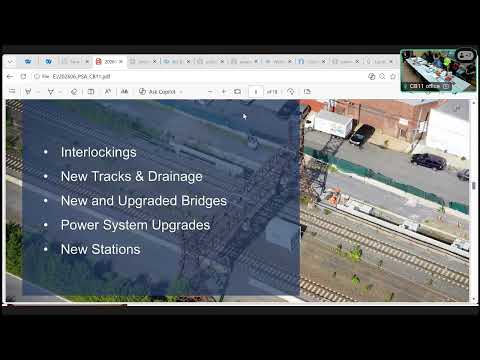
The project will bring Metro‑North service into Penn Station via the Hell Gate corridor and add four accessible stations in the Bronx — Co‑op City, Morris Park, Parkchester/Van Nest and Hunts Point — while upgrading roughly 19 miles of track, replacing power infrastructure and rehabilitating bridges and drainage conduits. "We're going to be bringing Metro North service into Penn Station and the Westside Central Business District," O'Donnell said during the presentation.
Why it matters: the work is intended to create a one‑seat ride from parts of the Bronx into Manhattan's west side, provide reverse‑commute options to Westchester and Connecticut, and extend the useful life of Amtrak track and structures in the corridor by several decades. The update included specific completion metrics the committee requested: areas of track and drainage, new manhole structures and station foundation progress.
Key details from the presentation: O'Donnell said about 5,200 linear feet of Track 1 at Parkchester/Van Nest is complete and that roughly 2,200 linear feet (about 45%) of Track 3 is in place. Across the alignment, 175 manhole structures (about 55% of the planned total) are installed and 21,135 linear feet of drainage pipe have been placed to mitigate frequent flooding. He listed bridge work completed at Bronxdale Avenue, Eastchester Road and several Bronx River spans, and said Van Nest substation foundation and other grounding work are finished.
O'Donnell described operational constraints that have affected the schedule: much of the work occurs on Amtrak right‑of‑way, and Amtrak's approval processes and required on‑site oversight have previously limited contractor productivity. "We need their permission to go on site... and they also have not proven to have all of the bandwidth or the bodies needed in order to do that oversight," he said, adding that Amtrak has recently approved double‑block outages and increased workforce availability to reduce interruptions.
Community engagement and construction impacts: MTA outreach staff described school STEM events, summer tabling and a project hotline and email for residents to report construction concerns. Residents raised questions about local staging areas (an access point at Stillwell was confirmed for materials and equipment), the shell/layup yard in New Rochelle (to be upgraded, not entirely new), and how construction traffic and lane closures will be managed for neighborhood streets.
Security and fares: board members asked how stations will be policed and whether there will be manned stations; O'Donnell said MTAPD and NYPD are coordinating roles and sampling of approaches will be finalized nearer to service start. On fares, MTA staff said Metro‑North will set pricing closer to revenue service but is exploring a discounted in‑city ticket similar to other MTA in‑city fares; details were not available at the meeting.
Schedule and risks: O'Donnell reiterated a project target of 2029 for initial revenue service and said stations will be opened in a staggered sequence to limit the effect of supply‑chain disruptions. "We're hopeful that we can... pull it back even further, but right now we have a confidence level in '29," he said.
What happens next: the project team said presentation materials are already posted on the project's webpage and will be circulated to the committee. Staff committed to follow up in writing on several neighborhood requests, including station‑level site names and outreach staffing for door‑to‑door canvassing.