Get Full Government Meeting Transcripts, Videos, & Alerts Forever!
Get email alerts on the Business Formation Statistics topic
No spam. Unsubscribe anytime.
U.S. Census Bureau expands Business Formation Statistics to include Puerto Rico
Summary
Census Bureau economists presented the Business Formation Statistics (BFS) and highlighted that Puerto Rico’s four application series are now published; formation-window series and municipal-level breakdowns are not yet available and have no release date. Presenters demonstrated how BFS uses EIN (SS‑4) applications as an early indicator of entrepreneurial activity.
The U.S. Census Bureau on a webinar introduced its Business Formation Statistics (BFS) dataset and confirmed that Puerto Rico is now included in the Bureau’s published application series, while several formation series remain unpublished for the territory.
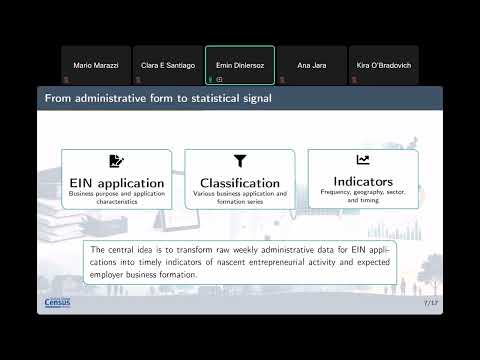
Emin Dinlersoz, principal economist at the Census Bureau’s Center for Economic Studies, said BFS tracks applications for Employer Identification Numbers (IRS Form SS‑4) as a near‑real‑time signal of new business activity. “BFS moves earlier in this process. It looks at applications for employer identification numbers in near real time and uses them to measure business initiations even before employer businesses are fully visible in standard administrative, or survey data,” Dinlersoz said.
Dinlersoz outlined the BFS taxonomy: Business Applications (BA) is the broadest series capturing entrepreneurial intent; High‑Propensity Business Applications (HBA) is a subset more likely to become employer firms; WBA identifies applications with planned wage payments; and CBA denotes corporate applications. He also described formation‑window series — for example, BF4Q (employer births within four quarters) and projected series (PBF4Q) — that link applications to later employer births.
The webinar included examples of BFS’s monitoring value. Dinlersoz said BFS captured a large post‑2020 surge in applications after an initial pandemic dip, concentrated in retail (notably e‑commerce) and professional services. He also showed how local shocks can be tracked: applications rose during North Dakota’s Bakken oil expansion and fell during the oil‑price bust. Using Puerto Rico data, he demonstrated that major hurricanes such as Hurricane Irene and Hurricane Maria produced sharp drops in applications, indicating that entrepreneurs delayed or abandoned plans during weather disasters.
Mario Marazzi, Puerto Rico FSRDC administrator at the Census Bureau, reviewed Puerto Rico’s inclusion timeline and current availability. He said Puerto Rico was added to some BFS outputs in March 2024 as a research product and later included in the national product; currently, the four application series are available for Puerto Rico but the full set of eight formation series and certain annual/sector breakdowns for the territory are not yet published and have no scheduled release date.
Marazzi also presented counts and comparisons: total application counts for Puerto Rico rose after 2017 (he described a rise from roughly 12,000 to nearly 25,000 total applications in recent years), and Puerto Rico reported a little more than 10,000 high‑propensity business applications in 2025, ranking 37th among 52 jurisdictions in that measure.
The presenters pointed participants to the BFS program page and the Business and Industry time series download tools on the Census website for published files and documentation. Dinlersoz and Marazzi emphasized that users should consult the methodological documentation linked on the site for classification rules, series definitions and caveats.
The webinar ended with a reminder that some BFS products (for example, granular formation series and municipio‑level releases for Puerto Rico) remain under research and that no timeline was provided for those expansions.