Get Full Government Meeting Transcripts, Videos, & Alerts Forever!
Get email alerts on the Transportation topic
No spam. Unsubscribe anytime.
Utah Developmental Disabilities Council urges expanded accessible transportation in Cache County
Summary
At a Cache County meeting, council representatives described gaps in rural transit, outlined voucher and mileage-reimbursement models, and offered competitive grants (typically $10,000'20$50,000) and a volunteer-driver pilot launching in July to increase door-to-door options for people with disabilities.
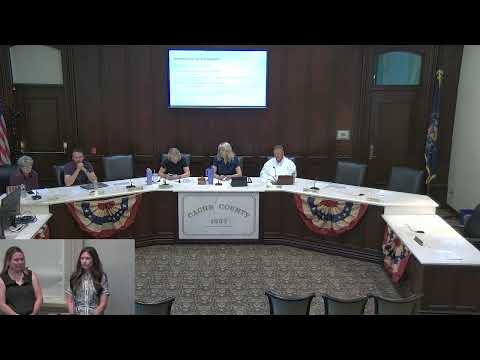
Representatives of the Utah Developmental Disabilities Council briefed Cache County officials on the council's 2022'2026 state plan and urged local leaders to expand accessible, affordable transportation options for people with intellectual and developmental disabilities.
"Transportation really can make or break that for a lot of individuals," said Elizabeth Osagera, executive director of the Utah Developmental Disabilities Council, during a presentation to county officials. Osagera said the council is a state entity housed in the Utah Department of Health and Human Services and is federally funded through the Administration for Community Living under the Developmental Disabilities Assistance and Bill of Rights Act.
The council highlighted four plan goals for 2022'2026, with transportation identified as a priority because it affects access to medical care, groceries and community life. Avery Walsh, a subcontractor with Brightar Consulting working with the council, told officials that national data and the council's survey show substantial service gaps: nationally, 145 standalone services cost about $781 million, and roughly 40% of rural U.S. counties offer no form of public transit. "Medicaid requires the individuals who receive waivers ... that they have access to transportation," Walsh said, explaining how gaps in transit infrastructure often shift costs onto providers.
Speakers described rural-friendly alternatives to fixed-route transit that the council supports and sometimes funds: voucher programs, mobility management and single-source contracting. "Voucher type programs or mobility management programs really helps put the dollars to use in a volume-based way and can serve a lot of people with a little bit of money," Walsh said, citing examples from other counties.
Alyssa Cronin, mobility manager at Bragg (the local association of governments), outlined Bragg's lifeline mobility voucher program, which offers mileage reimbursement and uses vetted volunteer or family drivers for critical trips such as medical appointments and nutrition access. Cronin said Bragg partners with Connect Transit and with a local nonprofit—Susie Senior Companionship Services—to provide door-to-door rides when family support is not available. "We are going to be starting that this fiscal year in July of actually having volunteers," Cronin said, describing plans to address liability and background checks before the pilot launches.
Osagera and Walsh explained how the council awards competitive grants to entities with tax identification numbers and follows the state competitive-bid process. Typical grants range from about $10,000 to $50,000 annually, and the council sometimes funds larger projects (they cited examples up to roughly $100,000). "It is about $50,000" was offered as the size of a current small health-related award the council is administering.
Officials in the room said they will connect county grant-writing staff with the council to explore potential applications. Osagera offered to share the council's full survey report and a list of participating cities and counties. Presenters also noted service growth locally: "we're easily doing between 500 and a thousand one-way trips every month," a speaker said, arguing uptake has increased as awareness has grown.
The presentation closed with an offer to help county staff identify funding opportunities and technical supports; presenters requested counties consider partnering on pilot projects and capacity-building grants that the council can fund.
The council did not request immediate formal action from the body; next procedural steps mentioned were (1) county staff connecting their grant writer with council staff and (2) the council sending the full report and contact information for follow-up.