Get Full Government Meeting Transcripts, Videos, & Alerts Forever!
Get email alerts on the Municipal Budget topic
No spam. Unsubscribe anytime.
Marshalltown council weighs cuts across services and directs staff to develop a smaller utility franchise-fee proposal
Summary
Council reviewed a menu of cuts and revenue options to address a $1.573 million shortfall — from vacancy management and program cuts to fee increases — and asked staff to pursue a phased 3% utility franchise-fee proposal and public-education plan.
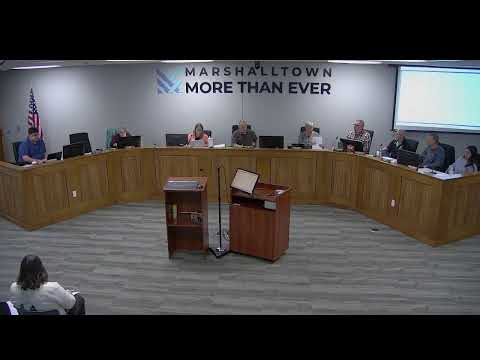
Marshalltown’s Jan. 19 budget workshop covered a broad list of potential cuts and revenue measures as staff sought council direction to begin closing an estimated $1.573 million FY27 general-fund gap.
Councilors and staff worked through dozens of line items and proposals, combining staff presentations, department input and public comment. Items discussed included eliminating the small mosquito-spraying line ($2,000), holding select vacancies open (estimated one-year savings roughly $160,000), adjusting aquatic-center hours and dates (estimated Wednesday-schedule savings of $7,150.50), retaining an outside building-inspections contract (Vinstra and Kim) rather than hiring two in-house FTEs, and canceling the downtown banner program.
Parks and recreation director Kelsey Stafford, describing the aquatic-center analysis, said, "We are suggesting closing on Wednesday because that would cause the least amount of disruption in our services compared to the weekend." Councilors split on full closure; staff was asked to model both preserving Wednesdays and a schedule-change scenario.
Public-safety and recruitment items were also on the table: Police Chief Chris Jones said the department remains short three officers and described how recruiting incentives have been used; the council discussed whether to keep a $2,500 annual recruiting-bonus budget in place or move it to alternative funding.
Arts and Culture Alliance funding (paid from local option sales tax) drew a public appeal from Amber Danielson, who asked council to preserve the partnership and offered a 20% reduction as a compromise. "Preserving this partnership is essential and in the best long-term interests of the city," Danielson said.
Staff also presented revenue ideas: a pet-registration program (modeled conservatively at up to $20,000 annually with a 25% compliance assumption), new cable-franchise revenue (first payment from Heart of Iowa, ~ $5,000), charging rent or administrative fees to the regional E911 commission (deferred to FY28 because of contract constraints), and raising recreation program fees (BLAST camp increases proposed; staff said financial-assistance options would remain available).
After reviewing the list and the remaining budget gap under multiple scenarios, councilors returned to the previously discussed utility franchise fee. Staff reminded the council that a 5% proposal failed a public vote in 2023 and recommended a smaller, phased 3% fee focused on essential services and accompanied by a clear revenue-purpose statement and public engagement. Councilors asked about ballot timing and special-election costs and generally agreed to direct staff to develop detailed options, revised revenue statements and an outreach plan for a potential future vote or general-election placement.
The council left most operational decisions to staff modeling and did not finalize staffing-level implementation details; staff will return to council with refined scenarios and timelines.