Get Full Government Meeting Transcripts, Videos, & Alerts Forever!
Get email alerts on the Infrastructure Water topic
No spam. Unsubscribe anytime.
Pelican Rapids approves engineering task order to begin lead service line replacement work
Summary
After an Apex Engineering briefing, Pelican Rapids council approved a task order to prepare designs and a PFA funding application to replace lead and galvanized water service lines; staff reported 846 services citywide with 33 confirmed lead lines and 57 galvanized lines.
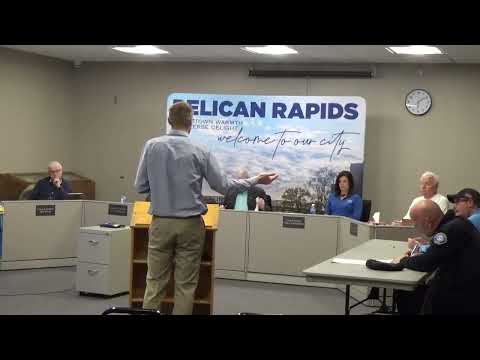
Bob Schleman, an engineer with Apex Engineering, told the Pelican Rapids City Council on Jan. 13 that the city has made a preliminary inventory of its water services and faces a multi‑year effort to remove lead from service lines. "We have approximately 846 water services. We've identified at least 33 of them are lead. There's another 57 that have been identified as galvanized," Schleman said, adding that galvanized piping is treated as lead for replacement purposes because of connection practices.
The presentation explained that the Environmental Protection Agency's revisions to the Lead and Copper Rule require public water suppliers to inventory and remove lead service lines, and that the Minnesota Department of Health and the EPA expect communities to be free of lead and galvanized services by 2033. Schleman said the Public Facilities Authority has allocated up to $1 million for Pelican Rapids in its 2026 intended‑use plan; with that amount the city estimates replacing about 20–25 services, depending on unknown conditions and contractor availability.
Council members asked how the city would verify the public side of services when private‑side inspection shows copper at the meter. Schleman said contractors will excavate at the curb stop during replacement work to determine material on the public side and that bid documents will assume replacement from the main to the meter when necessary; if the public side proves non‑lead, the bid will not include replacing that portion. He also warned the council about workforce and supply pressures: "There's a lot of unknowns... who's going to be doing this. That's going to affect price, availability," he said.
Schleman described an expedited schedule: engineering designs and an application must be submitted to the Department of Health and the PFA by March 31 to be competitive for 2026 funding. To meet that deadline, Apex requested council approval of task order No. 11 to provide the engineering services, including a supplemental scope to address private‑property complexities and public outreach. Lance Royum, city administrator, said the draft property‑owner agreement has been reviewed by city counsel and will be used to obtain access where required; owners who refuse will be documented and cannot be forced onto private property.
Council moved, seconded and approved the task order, enabling staff to proceed with design, outreach and the PFA funding application. Royum and Schleman said the city may reapply for additional funds in subsequent years if more financing becomes available. The council did not set specific prioritization beyond noting schools and daycares would be early targets for replacement.
Next steps: staff will finalize agreements and the design task order, schedule public meetings for affected property owners, and submit the application and plans before the March 31 deadlines. Construction procurement is likely in late spring or early summer 2026, with completion of some work possibly extending into 2027 depending on contractor availability.