Get Full Government Meeting Transcripts, Videos, & Alerts Forever!
Get email alerts on the Lead Service Line Replacement topic
No spam. Unsubscribe anytime.
Pelican Rapids approves engineering work to pursue lead service line replacements after engineer reports inventory
Summary
Apex Engineering told the Pelican Rapids City Council the city has roughly 846 water services, with at least 33 confirmed lead lines and 57 galvanized (counted as lead); council approved Task Order No. 11 to begin engineering and meet a March application deadline for up to $1 million in PFA funding.
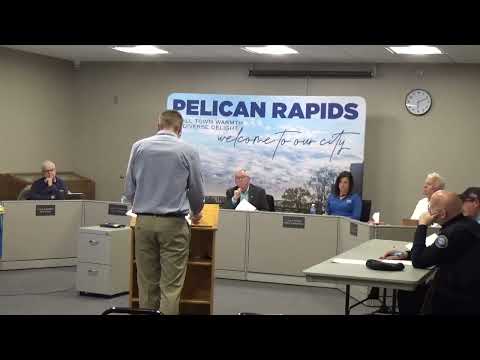
Pelican Rapids City Council on Jan. 13 approved a task order to advance engineering and grant application work for replacing lead and galvanized water service lines after an Apex Engineering presentation.
Bob Schleman of Apex Engineering told the council the city has "approximately 846 water services" and that "we've identified at least 33 of them are lead" with another 57 classified as galvanized and therefore treated as lead for replacement purposes. Schleman said the Environmental Protection Agency’s revised lead and copper rule and Minnesota Department of Health guidance require a complete inventory and a plan to remove lead and galvanized services, with a federal/state target that all services be nonlead by 2033.
Schleman said the city applied for Public Facilities Authority funding and was allocated up to $1,000,000 for lead-service-line replacement. He described that as "the maximum amount that you can be eligible for" and said the PFA estimate suggested that amount would conservatively cover 20–25 services. "That's probably a little bit low," Schleman said, adding the number of actual replacements will depend on unknowns in the public-side material and conditions uncovered during construction.
Council members pressed staff on practical issues. Council member Brian asked how the city would identify the public-side material when residents already know their private-side piping is copper; Schleman replied crews will dig at the curb stop during replacement work and determine whether the public portion is lead. He noted the city may not have documentation for many services in the right-of-way and that some private properties did not respond to inventory outreach.
Schleman flagged implementation risks the council will face: contractor availability and variable costs as communities nationwide move to replace lines, and the need to coordinate work on private property, where owners must sign an agreement to allow crews on their premises. "We may have property owners that say, 'No, we don't agree to it,'" he warned, and said in those cases the city would record the refusal in the file per EPA/MDH guidance but otherwise likely could not force entry on private property.
Schleman asked the council to approve Task Order No. 11 to complete engineering services, design plans and the funding application ahead of a March 31 deadline for application documents and to prepare specifications in time to bid construction in late spring or early summer. The council approved the task order by voice vote.
What happens next: staff and Apex will finalize design and application materials with an eye toward submitting the PFA funding request before the end of March. If awarded, the city expects to advertise bids later in the spring; construction could take place in 2026 with possible carryover into 2027 depending on contractor availability.
The council did not adopt a local ordinance or mandatory-entry policy at the meeting. Schleman and staff emphasized that some replacements will require property-owner consent and that additional state or federal funding may be available in future cycles if the single $1 million award does not cover all needed replacements.