Get Full Government Meeting Transcripts, Videos, & Alerts Forever!
Get email alerts on the Transportation topic
No spam. Unsubscribe anytime.
Pelican Rapids Council OKs MnDOT sidewalk project for Highway 59, agreeing to city cost share
Summary
Council approved participation in a three-phase MnDOT Highway 59 South project to add sidewalks and safety crossings, approving all three phases after MnDOT indicated it would cover the city's match for phase 1 and estimating a city cost share of roughly $87,000 if all phases proceed.
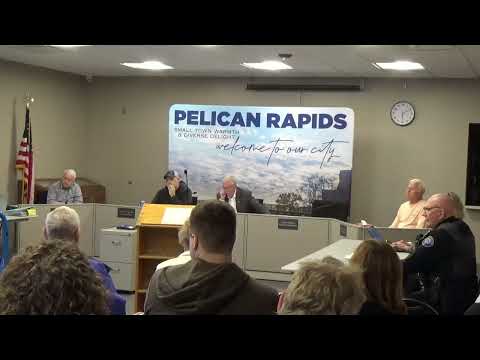
The Pelican Rapids City Council voted March 31 to move forward with a three-phase MnDOT Highway 59 South project that would add sidewalks and pedestrian safety features along the corridor.
Tom Pace, MnDOT Region 4, presented the plan and estimated costs for three phases. He said MnDOT will cover the city's match portion for phase 1 (described during the meeting as roughly an $80,000 equivalent) and that Transportation Alternatives (TA) funds would cover the bulk of the work. Pace described phase 2 as a mid-range estimate and said phase 3 carries greater hydraulic and right-of-way challenges that could increase costs.
Council and staff discussed materials and accessibility. Pace said sidewalks in the project's phases adjacent to commercial areas (for example in front of Holiday Station and the Dairy Queen) would be concrete to meet ADA expectations, while an existing bituminous trail would remain unchanged. He also noted the project could include marked crosswalks and possibly overhead flashers to improve nighttime visibility.
City staff described funding options. Danielle (Clerk) said a CD in the Special Improvement Fund holds about $157,000 and could be used for the city cost share. Council members emphasized that costs are estimates and could rise, especially for phase 3 where drainage and hydraulics are less defined.
After discussion, a councilor moved to approve phases 1, 2 and 3; the motion was seconded and carried by voice vote.
The next steps are for staff to receive the resolution and finalize the application materials with MnDOT; the council expects to sign required documents at a future meeting.