Get Full Government Meeting Transcripts, Videos, & Alerts Forever!
Get email alerts on the ECC Training topic
No spam. Unsubscribe anytime.
Emergency Communications Center training revamp halves time to PST1 milestone, training coordinator says
Summary
The Emergency Communications Center told the Audit Committee that a redesigned training program and new protocol software have cut the projected time to reach the PST1 qualification from about 215 training days to roughly 100, increasing classroom instruction and adding structured practice tools to reduce overtime pressure.
Deborah de Lauenta, training coordinator for the Emergency Communications Center, told the Arlington County Audit Committee that changes to the center’s training program have sharply reduced the time it takes trainees to reach the PST1 milestone.
De Lauenta said the ECC currently employs 34 public‑safety telecommunicators and supervisors and that the agency has redesigned the training sequence to prepare employees more fully before they move to the operations floor. Under the prior model, a recent trainee started on Dec. 9, 2024 and did not reach PST1 until February 2026 — about 215 actual training days (about 182 on‑shift training days). Under the current model she described, a trainee who started Jan. 5, 2026 completed the call‑taking portion on May 28 and is expected to reach PST1 within roughly 100 actual training days, a reduction of about 115 days (about 53%).
“We didn’t shorten the training program. We actually increased the amount of classroom training,” De Lauenta said, describing the classroom portion as a longer, more structured set of modules that include Priority Dispatch certification, basic dispatch school (a Virginia requirement), teletype certification, CPR and scenario‑based exercises.
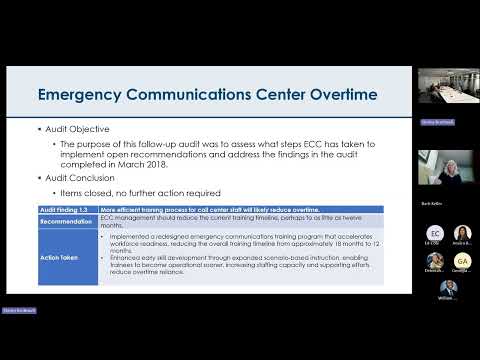
Audit staff said the change responded in part to a follow‑up recommendation from an earlier ECC overtime audit that advised reducing the operator training timeline from 18 months toward 12 months. De Lauenta described several specific changes intended to accelerate qualification without cutting content: expanding classroom instruction from roughly 33 days to about 49 days, shifting to a protocol (Priority Dispatch) that standardizes call‑taking questions, adding AI‑enabled practice tools that let trainees take practice calls during downtime, and moving some out‑of‑county certification in‑house to save travel time.
Committee members asked about the role of software versus organizational changes in the time savings. De Lauenta said it was both: “it was better organizational focus as well as shifting to Priority Dispatch or protocol system,” and added that the new software gives trainers better visibility into trainee progress via daily observation reports, quizzes and scenario management.
Members also asked whether the required certifications were still being met. De Lauenta confirmed that the program includes state teletype certification, CPR and other required credentials, and that the county is evaluating bringing certain external courses in‑house to reduce travel time and cost.
On workforce integration and turnover, De Lauenta said the ECC typically hires and trains five to 10 new employees yearly; trainees who complete PST1 are expected to join staffing counts and fill vacancies, but turnover remains a challenge. On average, she estimated, newer employees stay about three to five years.
Audit staff said they will close the outstanding recommendation tied to training timelines after reviewing ECC documentation of the changes and the evidence of shortened qualification times. No formal vote was recorded on that close; the presentation was received and committee members asked for additional data to be provided as the office tracks outcomes.
The committee’s discussion closed with staff appreciation and an invitation for ECC to return with further statistics on qualification times and overtime impact.
The Audit Committee did not take additional action at the meeting; follow‑up reporting on the ECC training timeline and the overtime recommendation closure will be part of routine audit follow‑up.