Get Full Government Meeting Transcripts, Videos, & Alerts Forever!
Get email alerts on the Noa Restructuring topic
No spam. Unsubscribe anytime.
Staff outlines three-track 2028 grant NOA to broaden access and add economic development stream
Summary
Staff presented a proposed 2028 Notice of Funding Availability that splits grant awards into three tracks—community development, economic development, and innovation grants—aiming to clarify eligibility, improve transparency, and better reach smaller organizations; committee members pressed for reporting and conflict-resolution procedures.
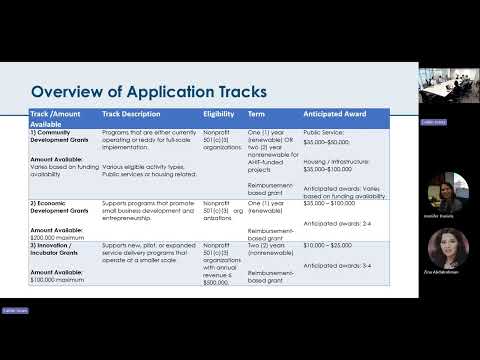
Staff presented proposed changes to the 2028 Notice of Funding Availability (NOA) during a committee meeting, saying the redesign focuses on refining the application and evaluation process while preserving the program’s intent. The proposal separates awards into three tracks: a traditional community development track, a new economic development track for workforce and small-business programs, and an innovation grants track for smaller pilots and expansions.
The presenter said the community development track largely retains existing eligibility and funding bands, with suggested award ranges of $35,000–$50,000 for public services and $35,000–$100,000 for housing or infrastructure projects. The economic development track is meant to concentrate evaluation on entrepreneurship and small-business outcomes and would be reviewed initially by Arlington’s economic development staff (Biz Launch) before recommendations come to the committee. “We’re kind of hoping to use some of their expertise to help really narrow and focus how these programs are going to be meeting the goals and the needs of the community,” the presenter said.
For smaller or newer organizations, staff proposed an innovation grants track with a simplified application and a maximum award of $100,000; staff said the track is intended for pilot programs, small expansions and service-delivery initiatives. Eligibility for that track would be limited to organizations with annual revenues at or below $500,000, with an expectation of three to four awards in the pilot year.
Committee members sought more transparency on how the economic development track will be documented and how potential disagreements between staff recommendations and committee priorities would be resolved. One member asked whether the committee would still receive application lists and scoring rationales; the presenter replied that recommendations and the justification for them would be brought to the committee after the Biz Launch/economic development review so members can review the outcomes and raise concerns.
Jennifer, a staff member, said another reason for separating economic development awards is that those awards do not count against the CDBG public-service cap, which can help meet HUD spending-rate requirements and provide more consistent ways to program CDBG funds. “By setting aside roughly $200,000 a year-ish for the economic development grants, that’s a more consistent way to spend our CDBG as well,” she said, while noting the $200,000 figure is a maximum and actual allocations could be lower.
Staff emphasized the proposal is a pilot and that the committee could be reinserted into the scoring process or pursue a hybrid model if members prefer. The presenter also noted that unspent funds in one track could be reallocated to others if needed.
Next steps: staff said the NOA is scheduled for release in early July, with an NOA workshop on July 13, a pre-application deadline in early August, full applications due Sept. 16, applicant notifications around Sept. 23, proposal discussion sessions on Wednesdays in October, and final ranking at the December meeting. The committee did not take a formal vote on the NOA restructure during the session; staff characterized the item as a proposal to be piloted and refined with committee input.