Get Full Government Meeting Transcripts, Videos, & Alerts Forever!
Get email alerts on the Personal Delivery Devices topic
No spam. Unsubscribe anytime.
Delivery robots to begin food deliveries in Arlington; disability commission presses company on ADA, safety and reporting
Summary
AV Ride told Arlington’s Disability Advisory Commission it will launch a small fleet of delivery robots on Wednesday the 17th, using opt-in partnerships with Uber Eats and GrubHub. Commissioners raised concerns about narrow sidewalks, interactions with mobility devices, vandalism and complaint channels; AV Ride said robots will 'always defer to human beings' and provide local ops and contact channels.
AV Ride plans to begin robot food deliveries in Arlington on "Wednesday the 17th," company representative Brett Swanson told the Disability Advisory Commission, describing a small initial deployment of about "five to ten" robots that will operate on sidewalks and crosswalks through opt-in restaurant and diner pairings on Uber Eats and GrubHub.
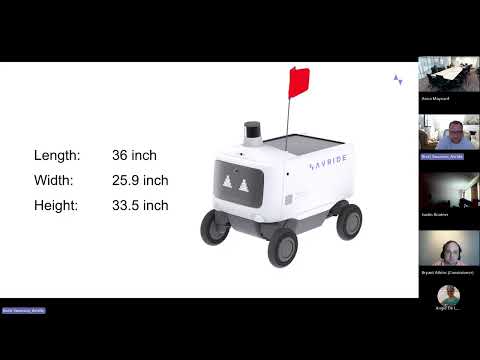
Swanson said the delivery unit is roughly 36 inches long, 26 inches wide and 36 inches tall, weighs about 180 pounds and travels at an average 2.1–3.5 mph. He described the vehicle’s sensor suite — six cameras, multiple ultrasonic sensors and LIDAR — and said the company’s perception system tags humans and objects up to 150–200 feet away. "We are 99.9% fully autonomous," Swanson said, adding that the system will hand off to a human operator when the robot encounters a situation it cannot resolve.
Commissioners and guests pressed the company for specifics about accessibility and safety. Chair Karen Odon asked about "ADA path awareness," and Swanson said the robots are programmed to detect people using wheelchairs or canes in advance and to yield: "We're always going to defer to human beings," he said. He added that narrow sidewalks and problem intersections will be identified during pre-launch mapping and can be excluded with geofencing and "red zones." Swanson also said local operations staff will be staffed to respond quickly if a robot needs retrieval or repair.
Commissioner Brian Atkins raised the risk posed by sidewalks that narrow around tree boxes or planters, asking whether the technology will default to giving right-of-way to the person with a mobility aid. Swanson affirmed the company's commitment to yielding and to working with the commission to identify and avoid congestion points.
Commissioner Justin Bner, who spoke as a wheelchair user, said Arlington sidewalks are already frequently obstructed and that micromobility devices have been vandalized. He asked whether AV Ride had considered routing devices to bike lanes or other lower-conflict paths. Swanson replied that the current plan is to operate on sidewalks and crosswalks only, but that routing will be adjusted where necessary and that operators will be available to remove or relocate units within minutes.
On privacy, Swanson said the company blurs faces and license plates in its data streams and will provide contact information and near-real-time Slack channels to partners and the county for reporting problems. On speed and regulation, commissioner Bryant noted a state code that allows speeds up to 10 mph; Swanson said AV Ride will operate at 2.1–3.5 mph in practice.
The commission asked where residents should report problems or bad interactions; Swanson said each vehicle will have a unique ID and contact information and that a local ops team will staff rapid-response channels. "My contact information is always going to be readily available as well as our entire operations team," he said.
Next steps: the company said it will begin a small, monitored rollout and return to the commission with updates. Commissioners requested continued communication and the ability to flag problematic routes for geofencing or exclusion.
Sources: Presentation and Q&A with Brett Swanson, AV Ride, at the Disability Advisory Commission meeting.