Get Full Government Meeting Transcripts, Videos, & Alerts Forever!
Get email alerts on the School Construction Bond topic
No spam. Unsubscribe anytime.
Board briefed on Future Ready Schools plan; committee narrows high-school size options, weighing costs and bond timing
Summary
Superintendent Dr. Meek updated the board on sizing and cost options for a potential new Othello High School, noting the committee narrowed plans from an early 1,600-student model to smaller options and that the district's estimated bond capacity is about $150 million; board members pressed staff on nonlinear cost jumps, prioritization and the timing of a possible interim capital levy.
Superintendent Dr. Meek briefed the Othello School District board on the Future Ready Schools committee's work, saying the group has narrowed recommended high-school sizes and is refining cost estimates and project scopes ahead of bond planning. "We're making good progress and we're really close to getting to a place where I think the group's thinking is coming together," Dr. Meek said as he introduced enrollment and facility-size analysis.
Dr. Meek said district high-school FTE numbers have hovered around 1,300 in recent years, and the committee has moved away from an earlier 1,600-student model. He told the board the current Othello High School permanent facility footprint is about 150,000 square feet and that a 1,200-student replacement would be roughly 120% of that footprint. New-site cost estimates presented to the board typically included a 400-seat auditorium, larger parking areas and upgraded athletic facilities; those components materially raise projected costs.
Board member Zaro pressed staff on why cost increases between some size options are non-linear, saying the jump from one capacity tier to the next looked large in the worksheets. "Why is it literally $3 million to add an extra 100 students, and then when we go from 1,400 to 1,500 it's almost $14 million?" Zaro asked. Dr. Meek and staff explained that thresholds for central/shared spaces (auditoriums, cafeterias, circulation and other core areas) and design efficiencies or inefficiencies create non-linear increases in square footage and cost for certain capacity breakpoints.
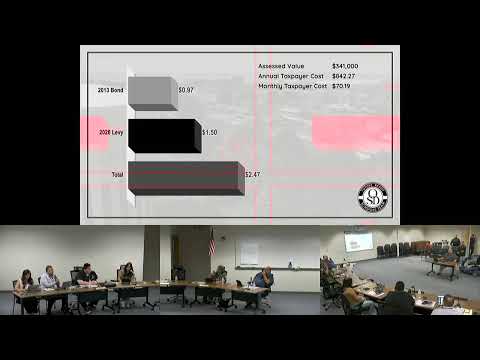
Staff reviewed financing context: the committee looked at a roughly $150 million bonding capacity and noted the district's 2013 bond payment is scheduled to end in December 2027. Staff said running a short-term capital levy to replace that payment could hold the local tax rate relatively flat until a bond measure is placed; capital levies are quoted per $1,000 of assessed value and may be run up to $150 per $1,000. Staff said if the board ran an interim capital levy and later passed a bond, the capital levy would terminate and the bond would become the primary repayment source.
No bond or levy decision was made. Staff committed to provide more refined cost estimates and a further briefing on July 27 so the committee and board can narrow priorities and sequencing for facilities such as auditoriums and athletic fields.