Get Full Government Meeting Transcripts, Videos, & Alerts Forever!
Get email alerts on the Personal Watercraft Policy topic
No spam. Unsubscribe anytime.
Residents Press for Jet-ski Ban at Mashpee–Wakeby Meeting; Officials Point to Enforcement, Legal Limits and Agreement Changes
Summary
Residents urged a ban on personal watercraft at a Mashpee forum, citing safety, noise and environmental concerns; state and town officials said land-side management, enforcement resources and the land‑management agreement will guide any change and that no decision was made tonight.
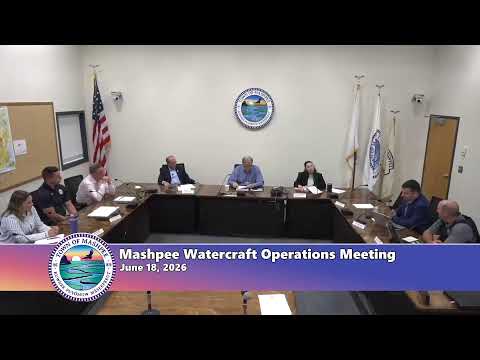
Town Manager Ronnie Collins convened an operational meeting on Mashpee–Wakeby ponds to gather resident complaints about jet skis, crowding and pollution, and to outline possible next steps.
At the heart of the meeting was a proposal led by resident organizer Sam Fisher, who said the group’s long-term objective is “a full ban of personal watercraft on our lake.” Fisher asked the town and state to explain how a ban could be pursued and urged immediate weekend enforcement from Environmental Police.
Opponents and several long-term residents urged more-targeted enforcement and public education instead of a blanket prohibition. Carrie Lore, a resident of John’s Pond, said enforcement and clearer signage would preserve family traditions while addressing bad actors. “Instead of bans, I would urge the town to increase the visible presence of the harbormasters on the waterway,” she said.
Environmental arguments for restricting personal watercraft were raised by Sarah Key, who told the meeting that jet skis are “much worse for spreading the cyanobacteria” because they churn the shallow water and can aerosolize blooms. Other residents described unbearable noise levels and reckless behavior on weekend afternoons.
State officials at the meeting cautioned that legal and jurisdictional limits complicate any immediate ban. Terry Smith of the Office of Fishing and Boating Access said his office’s authority is primarily the land side of public-access facilities and described how 320 CMR 2.00 gives regulators tools for management measures but places water-body restrictions and final approval largely with Environmental Police and state authorities. “The Office of Fishing and Boating Access and my role… involves the land side of the public access facilities only. Not the regulations that could potentially be in place or in put on to the water body,” he said.
That distinction matters because Mashpee–Wakeby spans municipal and state responsibilities and involves two towns (Mashpee and Sandwich). Officials described the normal amendment process: engineers and staff draft updates to a land-management agreement, departments and the town manager review them, and any final change would go to the select board for approval and, where required, Attorney General review or Environmental Police sign-off.
Officials also discussed near-term steps residents and the town can take: improve and consolidate ramp signage, station attendants or checkpoints at ramps to check registration and safety cards, run random safety inspections, coordinate saturation patrols with Environmental Police and local law enforcement, and consider cameras or other revenue-funded measures to increase enforcement coverage.
State representatives and agency staff reported some concrete near-term support: the Office of Fishing and Boating Access confirmed a state check for a quarter of a million dollars had been mailed as part of reconstruction funding for the facility, and staff said the agreement for the site is being reviewed to incorporate stormwater and environmental improvements. No votes or bylaw changes were taken at the meeting.
Officials closed by asking residents to continue reporting violations to Mashpee Police dispatch for immediate response, and they encouraged public participation in upcoming regulatory discussions in Sandwich; the Sandwich Conservation Commission will meet July 1 to consider rules for Ryder Conservation Land, where landing and parking contribute to weekend crowding.
What happens next: town staff will compile comments, review and propose amendments to the land‑management agreement and facility operations, and explore options for additional seasonal staffing, ramp operations changes and coordinated enforcement. Any formal ban or bylaw change would require town-level action (and, depending on pond acreage and jurisdiction, may require state review), so officials cautioned that a full prohibition would be a multi-step, multi-jurisdictional process.