Get Full Government Meeting Transcripts, Videos, & Alerts Forever!
Get email alerts on the Stormwater Drainage topic
No spam. Unsubscribe anytime.
Neighbors press developer on runoff; DRB asks 25‑year peak‑flow analysis and continues hearing
Summary
At the March 11 DRB meeting, neighbors opposed a conditional‑use request at 110–114 East Main Street over recurring flooding. The applicant proposed dry‑well mitigation; the board asked for a formal evaluation comparing pre‑ and post‑development 25‑year peak flows and continued the hearing to April 8.
The Development Review Board continued debate on CR2026-2, a conditional-use application involving modifications at 110 and 112–114 East Main Street, on March 11. Applicant Matt Pereizy recused himself from board deliberations but remained present as the applicant. The core dispute centered on stormwater: neighbors said the area already experiences frequent flooding and asked how any new building would be prevented from increasing runoff onto adjacent properties.
Pereizy and his civil engineer, Jeff Alleski of Catamount Consulting Engineers, described steps taken to retain and infiltrate roof runoff on site, including three dry wells installed after the initial building work. Alleski, sworn as a witness, explained the engineering constraints of the site — flat ground, no subsurface collection system to tie into, and downstream drainage limits — and said the chosen approach was to implement multiple dry wells to collect and infiltrate roof runoff. He said, “we're talking 3 4 inches of rain over a 24‑h hour period,” when describing the scale of 10‑ and 25‑year events and noted that the project’s relatively small added impervious area meant typical dry‑well practice can handle most routine storms but will be exceeded during large events.
Neighbors gave specific examples of repeated flooding. Martha McSherry (102 East Main) said construction projects exacerbate flooding and questioned whether the site is appropriate for additional housing. Danielle Morren and Bonnie Morren, who represent adjacent property owners, said they have experienced “flooding two years in a row” and asked what the town could do to guarantee the project would not increase water on their land. Jason Austerman asked what changed from the prior submission and requested that any extra runoff be fully calculated and designed into project plans.
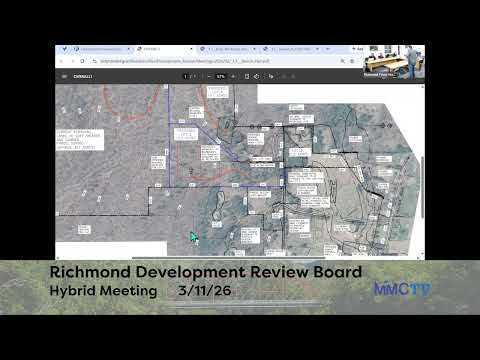
Engineer estimates provided in the hearing included an approximate new building footprint of 640 square feet and an additional dry‑well proposed with a plan area of about 130 square feet (depth to be confirmed by soils), which the team estimated would yield roughly 2,000 gallons of additional usable storage (assuming ~20% void space in crushed stone). The engineer said such features handle typical storms but will overflow in larger 10‑ to 25‑year events and that a formal soils evaluation and pre/post hydrologic modeling could be performed if the board requires it.
Action: After extended testimony and technical discussion, the board voted to continue the Pereizy hearing to April 8 and adopted a request for more information. The board’s written request requires the applicant to evaluate the post‑development peak flow for the 25‑year storm compared with pre‑development conditions for the "site" defined as 110, 112 and 114 East Main Street (the historical duplex and associated land). The DRB said it may require soils and design specifications and that any findings should be shown on drawings if the calculations indicate larger mitigation is needed.
Quotations from the hearing reflect the technical and community concerns: Jeff Alleski said, "we're talking 3 4 inches of rain over a 24‑h hour period," when describing return‑period storms; Danielle Morren said neighbors had "flooding two years in a row," and urged the board to ensure impacts will not increase downstream. The hearing was continued so the applicant can supply the requested 25‑year peak‑flow comparison and any associated design details.