Get Full Government Meeting Transcripts, Videos, & Alerts Forever!
Get email alerts on the Pledge Apartheid topic
No spam. Unsubscribe anytime.
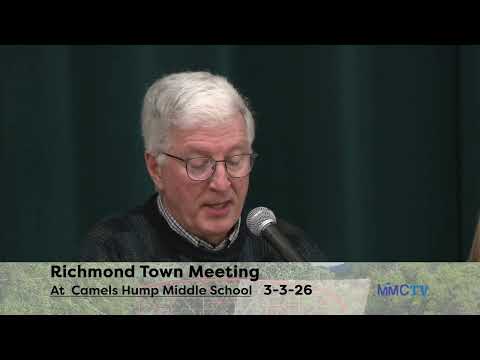
Richmond voters postpone debate on 'apartheid‑free' pledge after lengthy public exchange
Summary
After nearly three hours of floor debate and community testimony both for and against, Richmond voters voted by paper ballot to postpone indefinitely a nonbinding pledge that would declare the town "apartheid‑free" and oppose support for "Israel's apartheid regime, settler colonialism, and military occupation."
Richmond voters moved to postpone indefinitely a proposed nonbinding pledge that would have declared the town an "apartheid‑free community" and pledged to oppose "support to Israel's apartheid regime, settler colonialism, and military occupation." The motion to postpone prevailed on a paper ballot, 74 to 64, after an extended floor debate that drew residents from both sides of the issue.
Proponents framed the pledge as a local expression of opposition to racism and as a moral response to international human‑rights concerns. "We worked very hard to collect 5% of registered voters..." said Wafi Faul, a Palestinian American and organizer with Richmond Racial Equity, explaining how the article reached the warrant. Sophie Cassell, another supporter, argued the pledge was a local lever for larger policy change and cited a fiscal link: "about $300,000 of the taxes that Richmond residents pay annually to the federal government go to fund the Israeli military," she said, urging voters to take a stand locally.
Opponents voiced concern that singling out Israel could increase tension in town and harm Jewish residents. "I am in favor of [the article] only if it is amended so that Palestine and Israel are not singled out," said Chi‑Chi Barrett, who said she feared the pledge's language could place a target on Jews. Several Jewish residents described personal fear of backlash and urged either amendment or community dialogue rather than a unilateral pledge. Scott Silverstein, who said he had worked on amended language, urged talk and amendment so the town could avoid alienating neighbors.
Procedurally, the article was moved to the floor, and a motion to postpone indefinitely was made and debated. Because at least seven voters requested paper ballots, the moderator ordered a paper ballot for the motion to postpone. After the ballots were counted, the moderator announced that 74 voted to postpone indefinitely and 64 voted against postponement. The moderator declared Article 3 postponed indefinitely; per state law and the moderator's ruling, postponement kills the article for this meeting but it can be reintroduced at a future warned meeting or by the selectboard.
The exchange included repeated calls for follow‑up community engagement: speakers on both sides urged post‑meeting opportunities to meet, amend language, or pursue forums for deeper conversation. The meeting moved on to other business after the postponement.
Article provenance: the discussion began with Article 3 being read and moved to the floor (article text read at the start of the Article 3 sequence) and concluded with the paper‑ballot count and announcement of the result.
Next steps: with the article postponed indefinitely, supporters said they will continue work on amended language and outreach; opponents urged attention to community safety and dialogue.