Get Full Government Meeting Transcripts, Videos, & Alerts Forever!
Get email alerts on the Multi Use Paths topic
No spam. Unsubscribe anytime.
Advisory group backs quick‑build "neighborhood connector" multi‑use paths, urges pilot testing
Summary
Advisory members recommended the city present concise recommendations to council endorsing temporary, quick‑build multi‑use ‘‘neighborhood connectors’’ (10–12 ft), testing permeable surfacing, prioritizing high‑need corridors, and collecting data before major reconstruction.
A city advisory panel recommended that Littleton’s council endorse a program of pilot, temporary "neighborhood connector" multi‑use paths that can be evaluated before committing to permanent reconstruction.
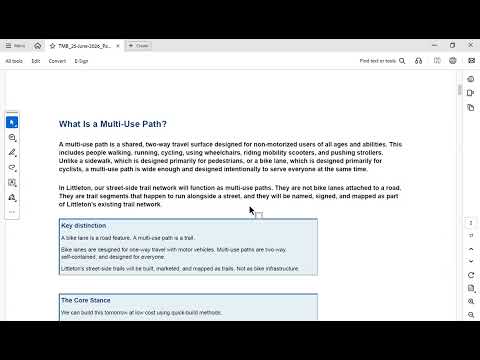
At a study‑session meeting, a staff presenter defined multi‑use paths as 10‑ to 12‑foot street‑side shared facilities that accommodate walking, wheelchairs and bicycles and act as connectors between neighborhoods and the existing trail network. The presenter said temporary, low‑cost barriers and modular surfaces would allow the city to test demand, safety and maintenance requirements without incurring the multimillion‑dollar cost of full street rebuilds.
Why it matters: panel members said quick builds would let the city prove routes, measure ridership and curb political pushback before spending heavily on curb realignment or full reconstruction. Members also argued properly designed connectors could advance ADA access and reduce pressure to build parking by making short trips walkable.
Cost and design tradeoffs: presenters described options ranging from inexpensive plastic grid pavers filled with crusher fines to porous asphalt and pervious concrete. Katie, a committee member who researched materials, noted some permeable products carry warranties and facilitate drainage, but cautioned they require correct installation and ongoing maintenance to avoid clogging and premature failure.
On ADA and maintenance, staff warned that some retrofit corridors may not immediately meet full curb‑ramp requirements and that porous surfaces can demand extra cleaning equipment; the group urged the council packet to acknowledge these constraints rather than obscure them.
Priorities recommended to council: members proposed (1) present a concise set of bullets emphasizing "neighborhood connector" language, (2) prioritize corridors that close gaps in the trail network, (3) pilot quick‑build treatments before final design, (4) allow multiple permeable surfacing options, and (5) brand the program for public clarity.
Next steps: the advisory group will condense recommendations for the Sept. 8 council study session and request survey results and Arapahoe County study materials to be attached to the packet. The panel emphasized that pilots be accompanied by clear evaluation metrics and public outreach.