Get Full Government Meeting Transcripts, Videos, & Alerts Forever!
Get email alerts on the Data Centers Zoning topic
No spam. Unsubscribe anytime.
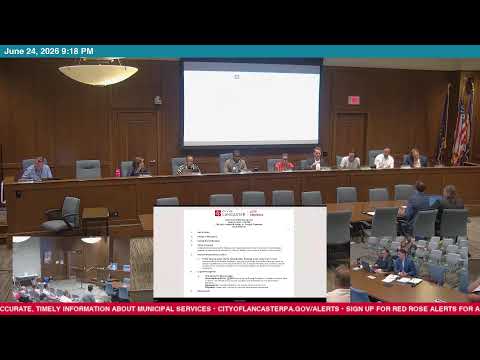
Lancaster City Council tables data‑center zoning amendment after hours of public testimony and legal questions
Summary
City staff presented a revised zoning text amendment that would define "data center" and limit future facilities to 16 suburban manufacturing parcels with new performance standards on noise, water, energy and decommissioning. Following extensive public comment and concerns about a grandfathering clause, council voted to table the ordinance for clarifying language and solicitor input.
City Council on Wednesday put off final action on a zoning text amendment that would create a distinct land‑use category for data centers and regulate future proposals with performance standards on noise, energy, water and decommissioning. Council voted to table the ordinance to the next regular meeting after hours of staff presentations and extensive public testimony.
The amendment, as presented by Christopher Delfs, director of community planning and economic development, would define a data center as “a facility whose primary purpose is the centralized storage, processing, management, or dissemination of digital data, information, or applications” and would require applicants to submit pre‑ and post‑construction noise studies, air quality reporting, an energy management plan, a water utilization report, decommissioning plans with financial security, and emergency response plans. Betsy Logan, planning bureau chief, told the council staff narrowed where data centers could be allowed — removing the larger Central Manufacturing district from eligibility and confining the use to 16 parcels in the Suburban Manufacturing district to limit community exposure.
The ordinance also preserves a special‑exception approval pathway through the zoning hearing board rather than making data centers a conditional use decided by council. Council and staff said the intent of that approach is to rely on the quasi‑judicial expertise of the zoning hearing board and to preserve the city’s ability to participate as a party in hearings. Neil Albert, special counsel for the city, cautioned that either body must apply the same legal standards, and he advised the council to be careful about making significant textual changes at final reading because such edits can invite legal challenges and re‑referral to county review.
The hearing produced extensive public comment. Residents and technical experts raised repeated concerns about construction and long‑term operational noise (including low‑frequency vibration), the adequacy and timing of post‑construction noise tests, air‑quality impacts in a region already identified as having poor air, potential strain on water resources and closed‑loop cooling, the sufficiency of enforcement mechanisms (including the scale of fines), and the transparency of prior approvals for two projects already in the pipeline at Greenfield Road and Harrisburg Pike. Several speakers urged the council to remove the ordinance’s pending‑application clause, make data centers a conditional use, or adopt a temporary moratorium to allow more public review.
Tony Dastra, a resident who testified, asked the council to strike the grandfathering clause and to make data centers a conditional use, saying the clause “made me as a member of the public feel as though these data centers are actually not on solid legal foundation.” An acoustics consultant, Christopher Brooks, criticized the ordinance’s noise approach as “woefully inadequate,” calling ambient‑noise comparisons a poor metric and urging design‑stage noise controls rather than post‑construction remedies.
Staff responded that the two projects already under contract are governed by separate community benefits agreements and that the pending‑applications clause was intended to preserve those contractual commitments rather than to exempt the projects from performance expectations. Staff also said the city cannot set state‑level air‑quality standards but will require reporting and rely on state regulators for enforcement of emissions rules.
After public testimony and follow‑up questions about ambiguous language in the drafted bill—particularly surrounding the so‑called grandfathering/pending‑applications section—Councilor Stoltzfus moved to table the ordinance to the council’s next meeting to allow the solicitor and staff to clarify the language. The motion was seconded and carried on a roll‑call vote; the council president declared the motion passed and adjourned the meeting.
Council will revisit the ordinance at its next regular meeting. In the meantime, councilors and staff said they intend to address outstanding drafting ambiguities and to confirm the interplay between the draft zoning text and the existing community benefits agreements for the two pending projects.