Get Full Government Meeting Transcripts, Videos, & Alerts Forever!
Get email alerts on the Utility Damage Prevention topic
No spam. Unsubscribe anytime.
Underground Safety Board workshop weighs rules to manage surge locator workloads
Summary
Stakeholders at the Underground Safety Board workshop described repeated ticket surges that overwhelm small operators (examples: 480 tickets in one day; a small system handling 20,000 USA tickets a year) and offered practical fixes including phased schedules, enhanced positive response records, throttling/alerts, and stronger enforcement.
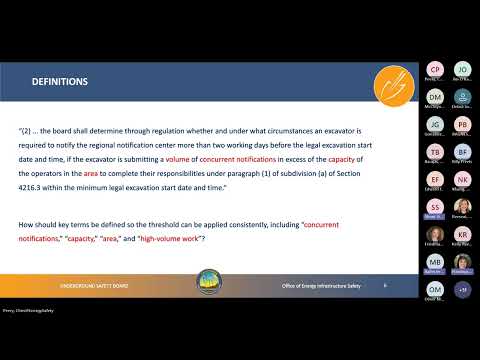
Member Simmonian convened an online Underground Safety Board workshop on draft regulations under Government Code 4216.1(b)(2), asking stakeholders how to define and respond when excavator notifications overwhelm local operator capacity. Staff reminded participants the board must adopt implementing regulations by July 1, 2027.
The session focused on two questions: how to define a workload threshold trigger (concurrent notifications, operator capacity, and geographic unit) and what regulatory response and documentation should follow if the threshold is met. Staff emphasized the need for practical, measurable definitions that protect safety without restricting standard or emergency notifications.
Operators and notification-center staff described multiple concrete problem patterns. Joe Derby, a water-distribution operator from a rural county, said his three-person crew handled more than 20,000 USA tickets in one year and recalled days with hundreds of tickets that required many hours of administrative work. James Winggate of USA North 811 gave a specific example of a small telecom that received 63 tickets in February and 480 in one day from the same excavator conducting power-pole work, and warned that no U.S. state has a fully solved system for these surge events.
Speakers identified common workload-amplifying behaviors: a single contractor or their subs submitting large batches of tickets at once; automated high-speed submissions; duplicated or partially duplicated tickets; broad or overextended GPS polygons that expand the response area; and repeated renewals of tickets (for example, pole-inspection tickets that are renewed months later). Several locators said even 'no conflict' closures take many hours of clerical work when volume spikes.
Participants proposed a set of practical tools rather than a single technical fix. Recurrent suggestions included:
- Enhanced Positive Response (EPR) and document exchange: several operators and USA North urged adding a documented exchange in the ticket system—excavators upload site delineation photos and proposed schedules while operators upload marking photos and negotiated schedules—so agreements are verifiable in-system rather than on paper.
- Phased scheduling and negotiation: when a ticket indicates long linear work or a large project, systems could require or automatically propose phased start dates so operators locate in a planned sequence rather than being hit with one simultaneous due date.
- Throttling and on-screen alerts: regional notification centers could detect very rapid submission patterns from a single account (or large immediate batches) and display warnings, slow submissions, or meter start dates so the system does not become dominated by a few fast callers.
- Ticket metadata improvements: add structured fields (prime contractor vs. subcontractor, site contact for field crews, photo of bracketed area, linear feet or project identifier) and ensure emails/notifications are sent to both the ticket creator and the field contact so crews actually receive confirmation.
- Per-utility and per-area baselines: several speakers recommended baselining an operator’s average workload (for example, normal daily or recent historical volume) and triggering controls when a percentage (one suggestion was ~150%) of normal workload is exceeded; others suggested allowing utilities to set temporary thresholds when short-staffed.
- Enforcement measures: multiple operators urged stronger, faster penalties for abusive practices such as false emergency-ticket submissions or chronic renewal abuse, noting that current enforcement requires complaint filings and is often slow.
USA North and Dig Alert staff stressed implementation constraints: ticketing databases can accept additional fields but don’t currently perform complex, real-time weighted capacity calculations without development and funding. James Winggate recommended starting with simple, auditable measures and iterating as data and resources allow.
The board staff asked for input on the minimum documentation that would make negotiated schedules verifiable; operators generally favored in-system EPR records and noted the need for 811 centers to surface that information to field crews. Several utility operators suggested business-hour submission windows or other submission-time controls to reduce late-evening tickets that shorten effective working time.
Member Simmonian closed by thanking participants and noting staff will review feedback to inform the regulatory drafting. The board meeting in Riverside on July 13–14 was announced for further consideration and written comments were invited to the board’s email (corrected contact below). Several participants continued to urge a focus on enforceable penalties and practical pilotable system changes.
What happens next: staff will analyze comments for definitional options (timing vs. submitter vs. project vs. geographic clustering), technology needs, and documentation standards; stakeholders can submit additional, written examples or data to help the board scope feasible regulatory triggers and the enforcement approach.
Contact and submission (corrected from transcript): submit written comments to digboard@energysafety.ca.gov or contact staff at chris.p@energysafety.ca.gov. The board emphasized the July 1, 2027 regulatory deadline.