Get Full Government Meeting Transcripts, Videos, & Alerts Forever!
Get email alerts on the Land Use topic
No spam. Unsubscribe anytime.
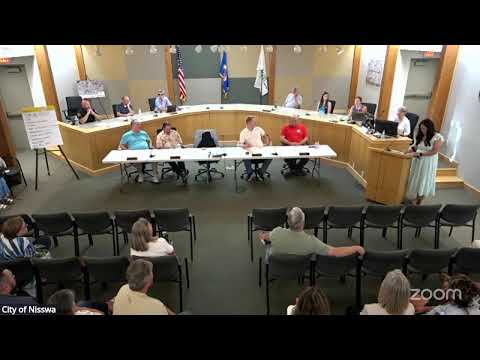
Nisswa planners highlight ordinance changes amid a contested lakeshore access dispute
Summary
City planner Steven Timlin summarized May ordinance revisions easing some accessory-structure permitting (no permit required for accessory structures up to 120 sq ft meeting setbacks). Residents pressed the council over a disputed public access at Grand View Lodge; council recounted a prior 3–2 vote to deny provisional approval for a shed pending planning and board review.
City planner Steven Timlin used the June town hall to highlight recent revisions to Chapter 20 of Nisswa’s land‑use code that reduce permitting burdens in some cases. "We now no longer require a permit for a structure that's up to 120 square feet," Timlin said, adding that such structures must still meet setbacks and impervious-surface limits.
Timlin and council members reviewed remaining limits for larger accessory structures—screening, 30‑foot setbacks when footprints exceed certain thresholds, and the conditional-use or variance process for deviations. Staff emphasized that variances should be limited to properties demonstrating a practical difficulty (for example, constraints from wells or septic systems), and that repeated patterns of variances can indicate the need to reexamine standards.
The planning conversation came amid a contentious shoreland-access question involving Grand View Lodge. Council members described an appeal and a special meeting earlier in the month that resulted in a 3–2 vote to deny provisional approval for a temporary shed adjacent to a public access easement and to preserve options for planning‑commission and board‑of‑adjustment review. Staff explained that resolving the exact width and ownership of the easement may require a title examiner, a real-estate attorney and a surveyor to produce a definitive map of the right-of-way.
Residents raised concerns about perceived inconsistency in how zoning rules have been applied over time and urged the council to pursue clearer, more predictable regulations and better early engagement with staff to avoid protracted variance proceedings.
Council and staff said they will continue work on ordinance implementation and encourage residents with development questions to consult the city planner early in project planning.