Get Full Government Meeting Transcripts, Videos, & Alerts Forever!
Get email alerts on the County Budget topic
No spam. Unsubscribe anytime.
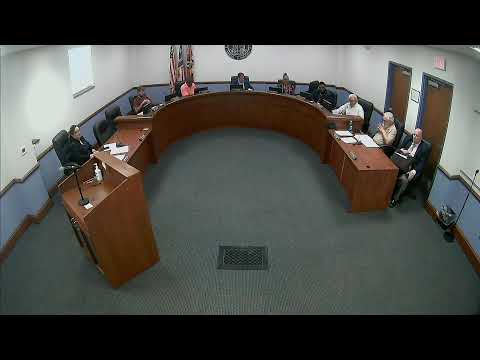
Anson County commissioners recess meeting after budget debate over fund balance, vacant positions and possible tax increases
Summary
At a continuation meeting, commissioners confirmed they must use pre-2025 property valuations under state law, debated using $2–4 million from fund balance versus higher tax rates, and requested detailed vacancy and five-year expenditure data before reconvening Friday to finalize the budget.
All right. Good evening, and welcome to tonight's meeting of the Anson County Board of Commissioners. Chair opened a continuation session of the June 16 meeting and the board spent much of the evening focused on balancing next year’s budget without imperiling the county’s unrestricted fund balance.
County staff told commissioners that Senate Bill 889 had been signed and ‘‘that does include us, so we're not able to use the new valuations,’’ Mr. Sassman said, confirming the county must use the prior (pre-2025) property values as the basis for tax-rate calculations. The change narrowed the available tax base and helped frame the board's budget options.
Why it matters: commissioners must choose between using fund-balance appropriations, cutting operating costs, or raising property taxes to close an estimated shortfall. Staff presented two headline scenarios: one that would require raising the tax rate to roughly $1.02 per $100 of assessed value to avoid drawing on fund balance, and another that pairs targeted cuts (including a proposed freeze of vacant positions) with a smaller fund-balance appropriation to limit the tax increase.
Commissioners asked for more detail before making a decision. They instructed staff to deliver, by the scheduled Friday reconvening, a full list of vacant positions (titles and cost), projected net cost for the Department of Social Services (DSS) vacancies after state/federal reimbursements, and a five-year expenditure breakdown grouped into salaries/benefits, operations and capital. ‘‘I’d like to see a proposal where we take $3 million out of fund balance and $1 million from somewhere else, and another with $2 million and $2 million,’’ one commissioner said, urging two concrete scenarios.
DSS director Lilly Jackson warned that freezing eight DSS positions would hinder delivery of mandated services. Jackson said many DSS positions are reimbursed—Medicaid positions at about 75%, child-support positions around 67%, and some Food and Nutrition Service positions currently near 50%—which affects the county’s net cost for filling vacancies. When asked about caseloads, Jackson confirmed ‘‘that is still correct’’ in reference to an earlier figure: roughly 10,000 Anson County residents currently receive Medicaid, about 45% of the county’s roughly 22,000 population.
Board members and staff also debated the county’s unrestricted fund balance. Staff recited audit figures showing the undesignated fund balance moved from about $12.1 million in 2021, peaked near $14.1 million in 2022, and trended down to about $8.5 million in the most recent audit; commissioners noted that maintaining a minimum unrestricted fund balance equivalent to 8% of the general-fund budget is a Local Government Commission (LGC) guideline and keeps the county out of LGC oversight. Commissioners and staff discussed that the 8% minimum on a roughly $47 million general fund equates to about $3.8 million.
Other budget pressures factored into debate: long-running revenue-neutral policies, a decline in fund balance over recent years, upcoming capital reimbursements that require cash on hand, and a two-year remaining debt service on an Emergency Services Center (about $250,000 per year) that will reduce future expenditures when retired.
Before adjourning, commissioners discussed employee compensation and benefits. Staff provided a cost estimate for a proposed cost-of-living adjustment (COLA) and discussed alternative approaches such as merit pay; commissioners asked for scenarios that assume a January effective date and half-year costs, and whether freezing positions and delaying COLA would materially change the tax-rate scenarios.
Formal action: a motion by Commissioner Gatewood, seconded by Commissioner Ellerby, to recess the meeting until Friday, June 26 at 9:00 a.m. passed; the chair announced the ayes prevailed and one commissioner stated opposition to the morning time. Commissioners asked staff to notify municipal governments that the county will use last year’s property values under state law so towns may finalize their own tax-rate decisions.
The board reconvenes Friday to consider the vacancy-cost list, the two fund-balance/tax scenarios requested and the five-year expenditure history, after which a budget ordinance and any new tax rate will need to be adopted by June 30 if the board proceeds with changes.
Ending: The board recessed the meeting until Friday, June 26 at 9:00 a.m.; staff committed to provide the requested vacancy and expenditure details ahead of that session.