Get Full Government Meeting Transcripts, Videos, & Alerts Forever!
Get email alerts on the Song Brown Overview topic
No spam. Unsubscribe anytime.
HCAI opens Song‑Brown primary care residency cycle with $31 million in grants; applications due Aug. 3
Summary
The Department of Health Care Access and Information (HCAI) detailed the 2026 Song‑Brown Primary Care Residency grant cycle, including a $31 million fund split across existing slots, Teaching Health Centers, expansion and new programs, new signatory and interview questions, and application deadlines (opens June 18; closes Aug. 3).
The Department of Health Care Access and Information (HCAI) opened applications for the 2026 Song‑Brown Primary Care Residency (PCR) grants and outlined key rules, deadlines and funding amounts during a June 11 technical‑assistance webinar.
John Wynn, program officer for Song‑Brown, said the application portal will open June 18 and the window closes Aug. 3 at 3:00 p.m., with early‑submission review available July 20 and award notifications planned for December. "The application opens June 18th...the application closes on August 3rd," Wynn said.
HCAI presented $31 million in total funding for this cycle. Wynn described the funding breakdown shown on the webinar slides as roughly $18 million for existing primary care residency slots, about $5 million for Teaching Health Centers (THC), and about $3.3 million each for expansion and new programs. Per‑slot maximums confirmed during the session include existing programs and THCs at up to $125,000 per filled first‑year slot (existing: up to five slots; THC: up to six slots), and expansion funding at up to $300,000 per first‑year slot (maximum three slots).
Applicants must provide organizational and program data that match IRS records, including legal organization name and address, STD‑204 payee and signatory information, facility type for each primary continuity clinic training site, payer‑mix figures for each site, and aggregate race/ethnicity data for current residents. Wynn emphasized that "funding shall be used to expand primary care services and funds shall not supplant existing federal, state, or local funds to provide primary care services."
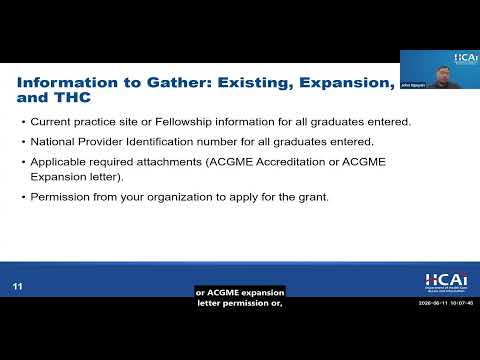
This year’s application includes three notable changes: (1) programs must add an additional institutional signatory with authority to enter agreements with the state; (2) residency programs must provide fellowship information for graduates; and (3) applicants will be asked whether someone in their organization is willing to participate in an interview with HCAI or a contracted HCAI partner. Presenters stated that opting into interviews is voluntary and "does not affect your score in any way."
HCAI walked attendees through the e‑application registration process and account roles. New accounts are assigned a grant preparer role by default; only accounts assigned the program director role may submit an application. The portal requires two‑step authentication for new applicants and offers a function to search for pre‑existing organizations to avoid duplicate entries.
Required attachments depend on the application type and phases completed: phases A–D require specific attachments at time of application, whereas if phases D–G are selected only a letter of sustainability is required. New programs seeking funding with a 25% match must document the matching plan; HCAI provided an example showing a $2 million award requiring a $500,000 local match to create a $2.5 million total budget.
HCAI also reviewed training‑site rules: only outpatient continuity clinic training sites should be entered, facility types must be selected from HCAI’s provided list (community health center, FQHC or look‑alike, Indian Health Service clinic, rural hospital, teaching hospital, etc.) and payer‑mix data should cover the prior 12 months and be entered in whole numbers.
Applicants were urged to verify that their organization name matches IRS/W‑9 records; incorrect names or missing signatory information can delay grant agreements. HCAI advised using the portal’s "save" and "next" buttons rather than browser navigation to avoid losing work.
For follow‑up questions, presenters directed applicants to the Song‑Brown PCR webpage and the PCR grant guide on HCAI’s site and provided the contact email songbrown@hcai.ca.gov and phone 916‑326‑3700. The team also noted a second technical assistance webinar on June 25.
The webinar recording and slide deck will be posted on HCAI’s website within 7–10 business days.